
Padel is played inside a box, and the box takes more ball impacts per hour than any other racquet court. A polycarbonate padel court wall is therefore chosen on two numbers: how the ball comes off it, and how the surface looks after two seasons of play.
Club owners usually arrive with a glass quote and ask for the difference. This is the comparison we hand back.
Panel schedule and the polycarbonate padel court wall build
- Panel: 12 mm clear polycarbonate, 2 m x 3 m nominal
- Joint: aluminium H profile with 3 mm expansion gap each side
- Frame: 60 mm box section, posts at 3 m centres
- Fixing: M8 through 10 mm holes, 12 mm from the panel edge
- Rebound: within 5 percent of 12 mm tempered glass on a rigid frame
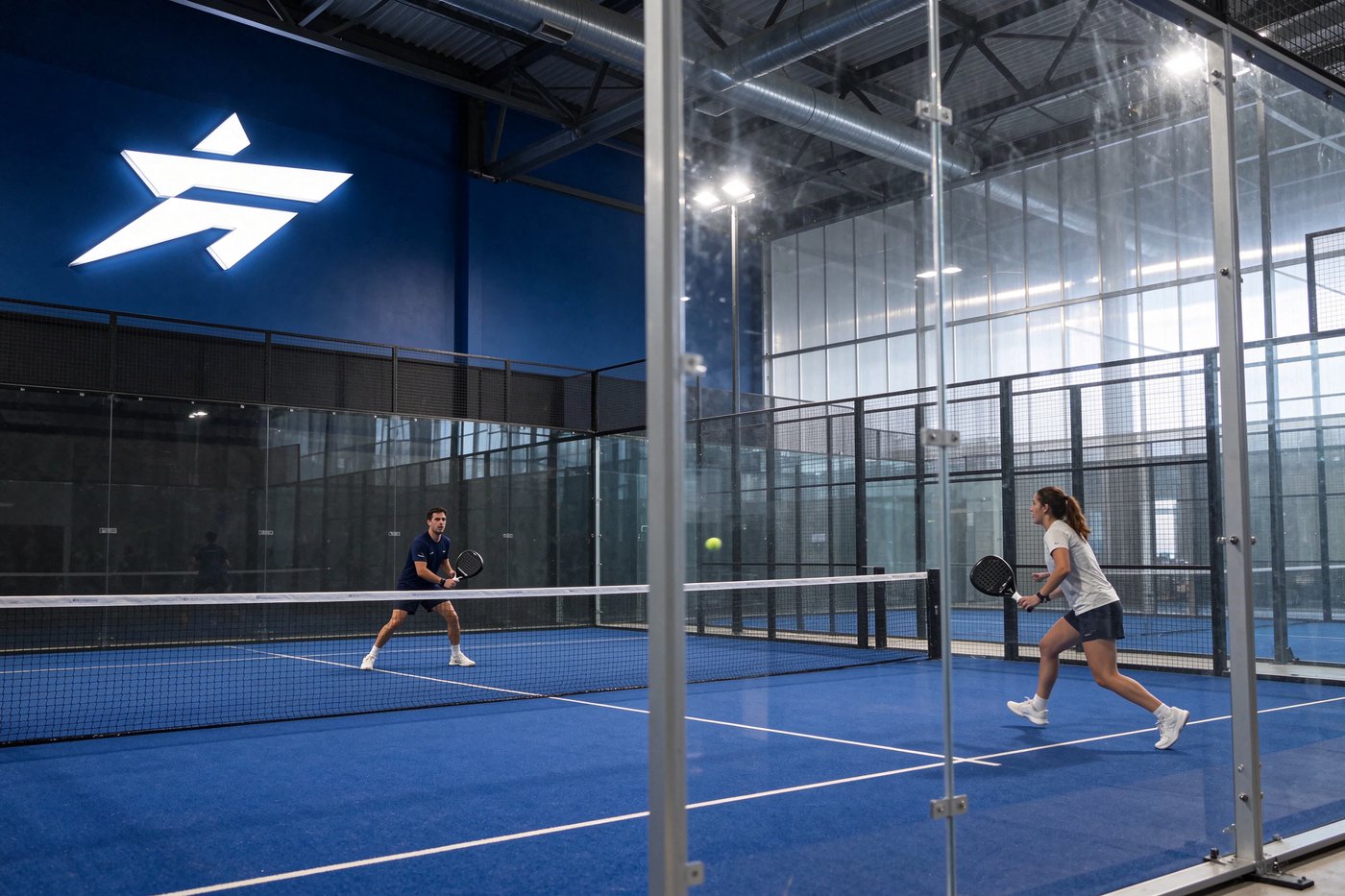
Twelve millimetres is the thickness that behaves like the glass players train against. At 8 mm the panel deflects on a smash and returns energy late, which reads to a player as a soft wall and changes how they volley. Thicker than 12 mm adds cost without changing the rebound in a way anybody can feel.
Joints, movement and the polycarbonate padel court wall frame
Polycarbonate moves about 0.5 mm per metre over a 30 C swing. A panel bolted tight on all four edges has nowhere to go and will bow or craze at the fixings. The H profile detail gives each panel 3 mm either side and keeps the joint line straight, which also stops a ball from catching a lip. Posts at 3 m centres keep the frame stiff enough that the wall does not drum on impact.
Appearance, cleaning and the polycarbonate padel court wall
Courts are cleaned with a squeegee and water, and a coated sheet resists the micro scratching that turns an uncoated face blue grey under floodlight. We specify coated both faces for indoor courts and coated outside only for outdoor, where the inner face is washed more often than it is abraded.
A full court is 20 panels plus spares. We schedule panels against the frame drawing so the joints land on the posts rather than between them.
Send court dimensions, wall height and frame layout to oversales@rpplexiglass.com for a panel schedule and price per court.
Court and rink glazing share the same frame and impact logic, and the rink case shows how a panel schedule is set against a perimeter that is not rectangular. polycarbonate ice rink shielding panels covers that part of the specification.
Frequently Asked Questions
Does polycarbonate change ball rebound?
A 12 mm clear sheet on a rigid frame rebounds within a few percent of tempered glass, which is inside normal play variation. Thin sheet on a flexible frame is what players notice as a dead wall.
Why not tempered glass?
Glass is the reference surface but it fails in a way that stops play: a shatter leaves the court closed for weeks. Polycarbonate takes the same ball loads without a catastrophic failure mode.
What haze value is acceptable?
Under 2 percent measured on a 12 mm sample. Above that the court reads as milky from the spectator side and sponsors reject the surface.