
An operator watches a cut through a polycarbonate laser engraver lid for hours, so the lid is judged as a window. It is not. It is the barrier that stands between a Class 1 enclosure rating and an open beam, and the specification has to start there.
This is the checklist we run when a machine builder sends a lid enquiry.
Wavelength, thickness and the polycarbonate laser engraver lid rating
- Sheet: 6 mm clear polycarbonate, both faces masked during cutting
- CO2 bed: 10600 nm blocked by the base resin, no tint needed
- Diode bed: rated filter at the diode wavelength, OD matched to class
- Impact: 6 mm resists a dropped tool and a workpiece kick
- Service temperature: continuous 115 C, well above a bed lid environment
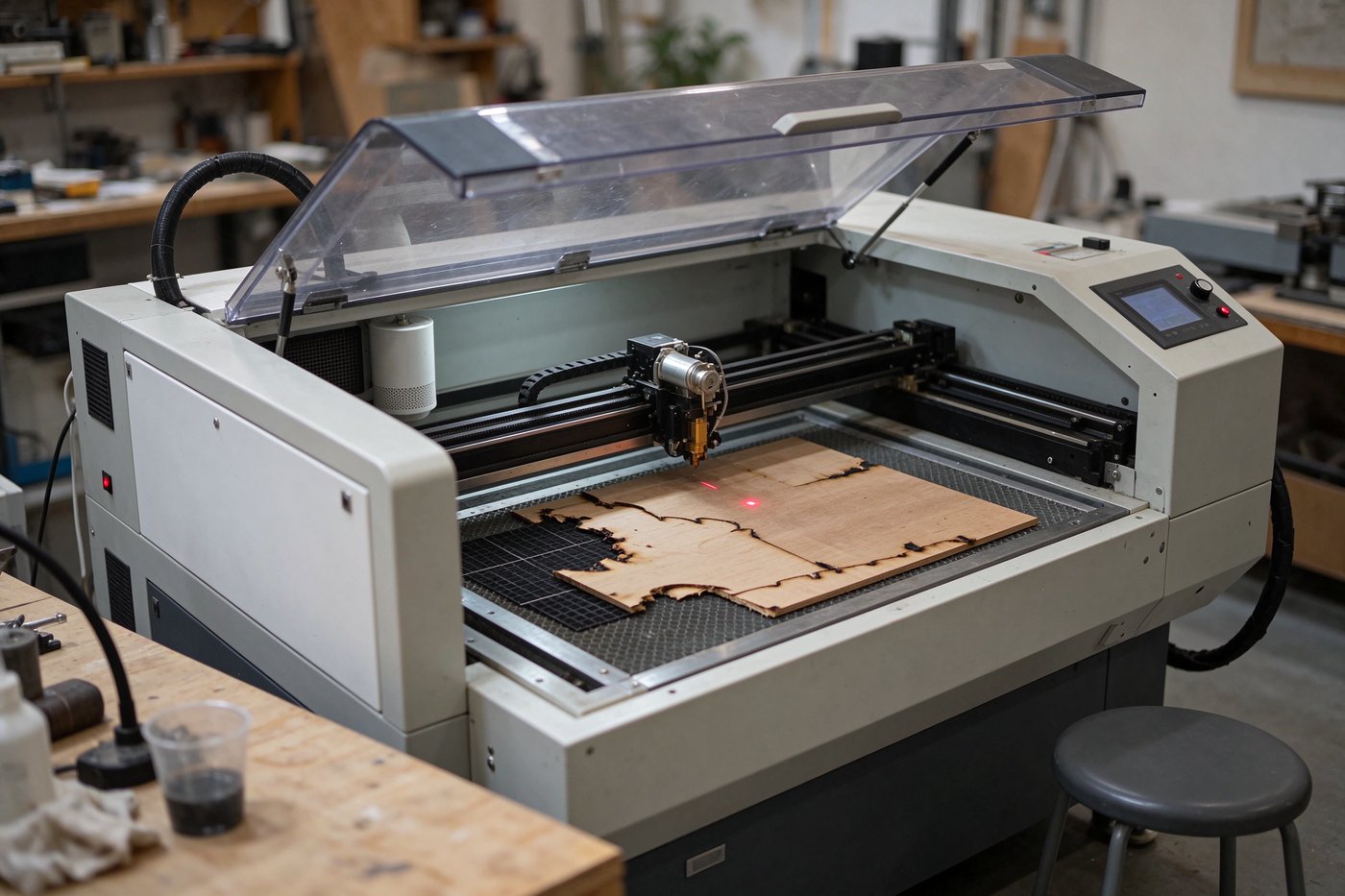
Machine guarding assessments at 10600 nm treat 6 mm polycarbonate as opaque with margin. The failure we see is not transmission but substitution: a fabricator replaces a damaged lid with 3 mm acrylic because it was in stock, and the enclosure rating is quietly lost.
Hinge load and the polycarbonate laser engraver lid frame
A lid on a 600 mm bed weighs about 4 kg at 6 mm. Two hinges at the rear take that load plus the moment of an operator lifting at the front edge, so the frame needs a 3 mm aluminium angle or a 6 mm polycarbonate stiffener along the lift edge. A lid with hinges screwed straight into sheet will crack at the holes within a few hundred cycles, and the crack always starts at the outer screw.
Interlock geometry and the polycarbonate laser engraver lid closure
The interlock actuator should sit on the lid frame, not on the sheet, because sheet moves with temperature and a 0.5 mm shift is enough to defeat a reed switch. We leave a 25 mm clear band along the closing edge for the actuator and a 3 mm gap for the gasket, so the switch trips before the lid seats rather than after.
Lids are cut to a machine drawing with hinge holes drilled to pattern and a masked face on the inside to protect the viewing surface until installation.
Send the machine model, bed size and interlock layout to oversales@rpplexiglass.com for a lid cut to drawing.
Machine builders who need a lid usually need a fixed cell window as well, and the filter grade selection for visible wavelength lasers is covered in that article. polycarbonate laser safety windows for laser cells covers that part of the specification.
Frequently Asked Questions
Does polycarbonate block CO2 laser radiation?
At 10600 nm polycarbonate is effectively opaque, and 6 mm gives a margin well above the transmission limit used in machine guarding assessments. Visible light still passes, which is what makes it a viewing window.
Can acrylic be used instead?
No for a CO2 bed. Acrylic absorbs at the same wavelength but it is brittle and it softens near the bed, and a cracked lid defeats the interlock. Polycarbonate holds both impact and heat.
What filter grade for a diode laser?
A diode emits in the visible range, so the lid needs a rated filter at the specific wavelength, not just a tint. Match the OD rating to the laser class on the machine plate.