
A polycarbonate press brake guard is usually bought after an audit finding, which means the purchase is under time pressure and the specification gets copied from the previous machine. That is how a guard ends up 2 mm too close to the tooling and gets removed within a month.
This page is the sequence we recommend instead, starting from the ram rather than from the sheet.
Ram speed, stopping distance and the polycarbonate press brake guard gap
- Ram speed: measure closing speed, do not assume catalogue value
- Stopping distance: speed times reaction time plus brake lag, measured
- Guard gap: stopping distance plus 25 mm clearance to the tooling
- Sheet: 10 mm clear polycarbonate, edges routed with 5 mm radius
- Supports: every 900 mm along the ram, tied to the frame
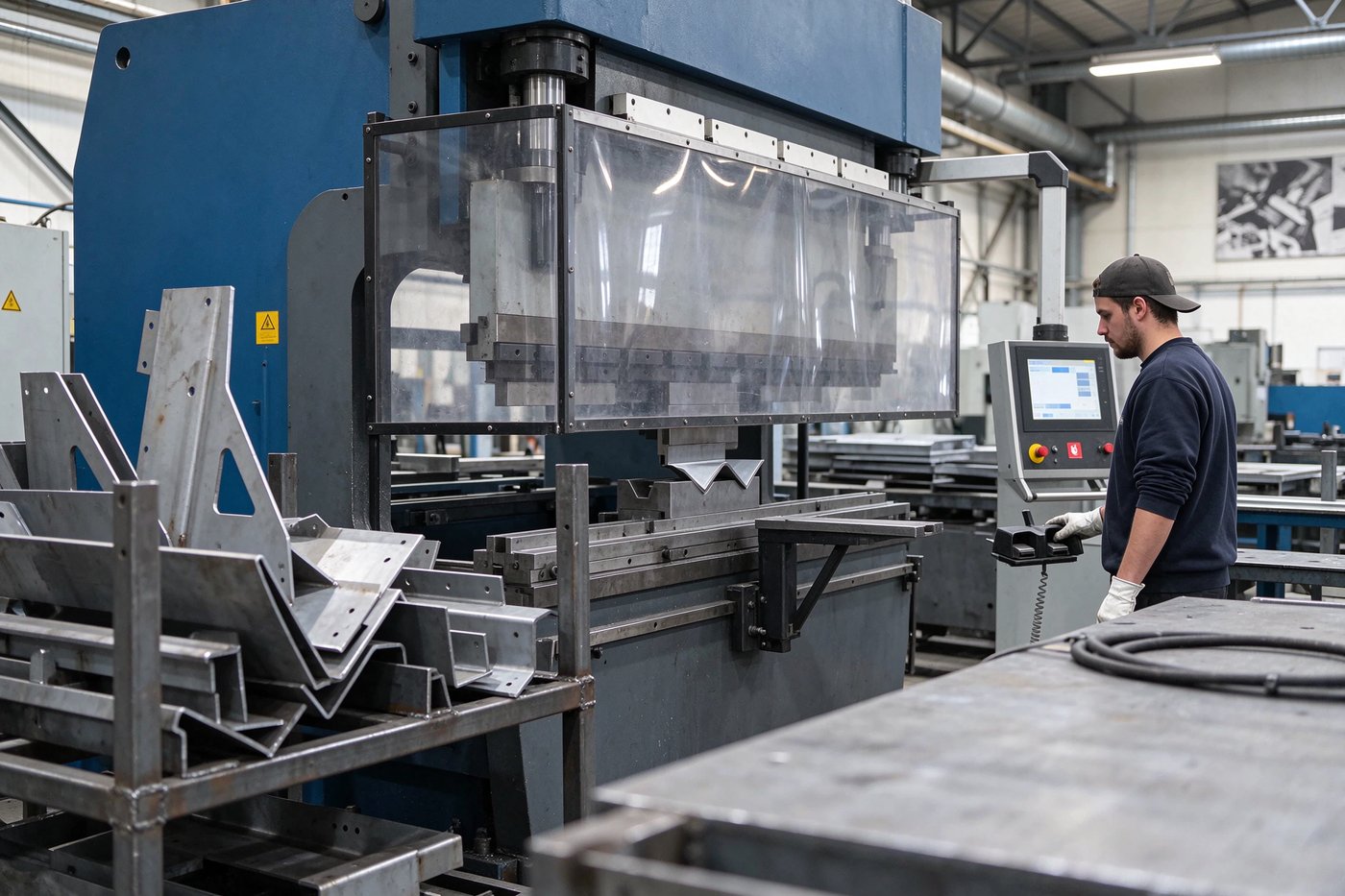
The gap is the number that gets copied wrong. A brake closing at 10 mm per second with a 200 ms total response travels 2 mm before it stops, so a guard 25 mm from the tooling is generous. A brake closing at 40 mm per second travels 8 mm, and the same 25 mm gap is now marginal once panel deflection is added.
Hinge, latch and the polycarbonate press brake guard setup
Tool changes happen several times a shift on a job shop brake, so the guard has to move. A hinge along the upper edge with a gas strut keeps the guard open while both hands are on the die, and a latch with an interlock switch means the machine cannot cycle with the guard raised. Guards that swing on a side hinge tend to drift out of alignment and start fouling the light curtain bracket.
Verification after fitting the polycarbonate press brake guard
Three checks settle whether a guard is right. Measure the gap at both ends of the ram, because a ram that is not level closes the gap at one end. Run the machine at full speed with a wooden block at the die and confirm the guard does not contact it. Then lift the guard and confirm the interlock prevents a cycle, which is the check auditors ask about first.
Guards are cut to a brake outline with hinge and latch holes drilled to pattern. Send the model and ram length and we will return a drawing for sign-off before cutting.
Send the brake model, ram speed and existing guard drawing to oversales@rpplexiglass.com and we will cut a guard to your interlock layout.
Fabricators guarding a brake usually have rotating equipment to cover as well, and the coupling guard note shows how a small enclosure is sized around a shaft. polycarbonate pump coupling guards covers that part of the specification.
Frequently Asked Questions
Does a physical guard replace a light curtain?
No. A light curtain trips the ram; the guard contains fragments and keeps hands out of the travel path during setup. Most fabricators run both, and the guard is sized around the curtain plane.
Which thickness for a 3 m ram?
10 mm at 3 m with supports at 900 mm centres. A single span of 10 mm over 3 m deflects enough to touch the tooling on a fast descent.
Can the guard be lifted for tool changes?
Yes with a hinge on the upper edge and a latch that is interlocked. A guard that can be lifted without tripping the machine will be lifted during a run.