
Every pool window project arrives at the same question: how thick should the acrylic be? The honest answer is that acrylic pool window thickness is not a lookup value; it is the output of a structural calculation that weighs three inputs – the water depth at the bottom of the window, the span of the unsupported glass, and how the frame holds the edges.
The three numbers that drive the thickness
- Water depth at the panel bottom – this sets the hydrostatic head in metres.
- Longest unsupported span – the wider the opening, the thicker the panel for the same depth.
- Edge restraint – a panel clamped on all four sides carries far less bending than a free-edged panel.
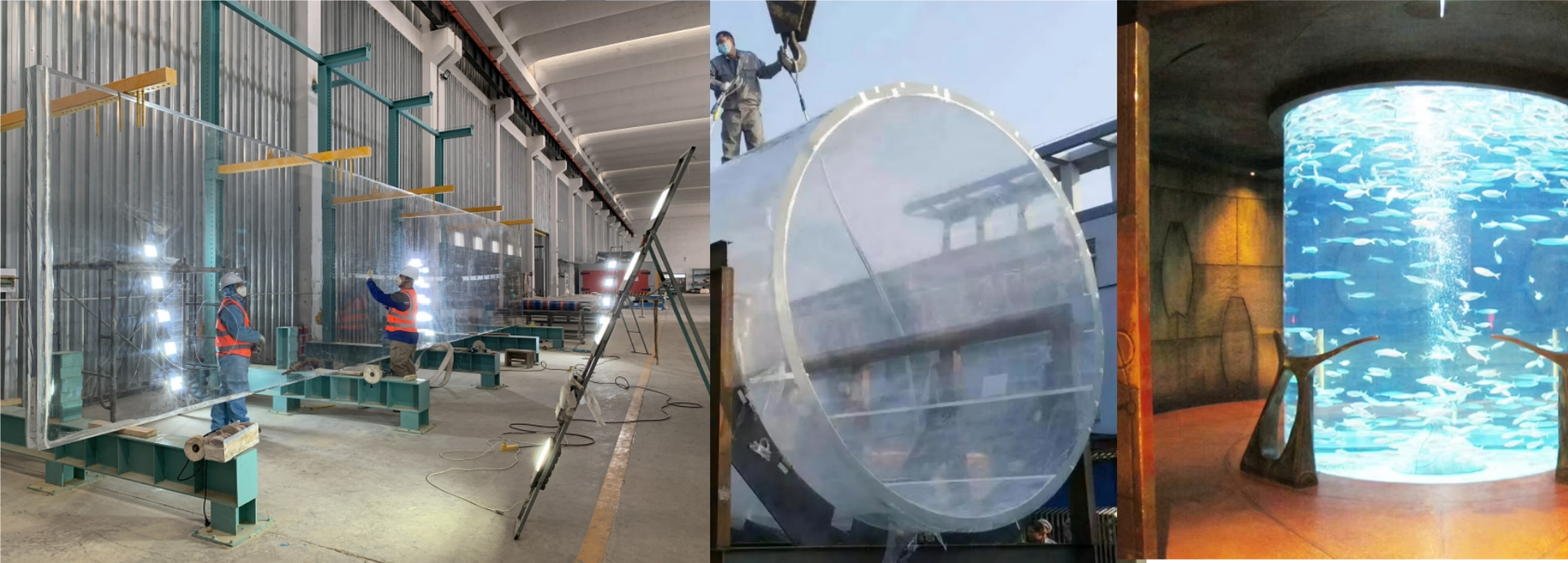
A realistic worked example
Take a window 1.2 m wide by 0.9 m high whose bottom edge sits 2 m below the surface, supported on all edges. The governing pressure is roughly 20 kPa at the window bottom, and with a span of 1.2 m the calculation lands in the 50 mm range for cell cast acrylic with a sensible safety factor. Double the depth to 4 m and the same opening climbs toward 75-90 mm. Change the frame to hold only two edges and the number moves again. This is why a supplier quoting one thickness for every pool is guessing.
The calculation discipline here is the same used for deep tank glazing; our article on large acrylic aquarium viewing panels explains how span and depth set panel thickness for water-holding acrylic.
Frequently Asked Questions
Q: Is 25 mm enough for a pool window?
A: Only for a very shallow, small, well-supported opening; most real pool windows require 40 mm to 90 mm depending on depth and span.
Q: Does edge support really change the thickness?
A: Yes, significantly; a panel clamped on all four edges can be thinner than a free-edged panel for the same load because bending is reduced.
Q: What data should I send for a thickness calculation?
A: Opening width and height, water depth at the window bottom, the frame support detail and any drawing.
For a project-specific quotation on cast acrylic panels, email oversales@rpplexiglass.com with your opening size, water depth, support layout and drawing.