
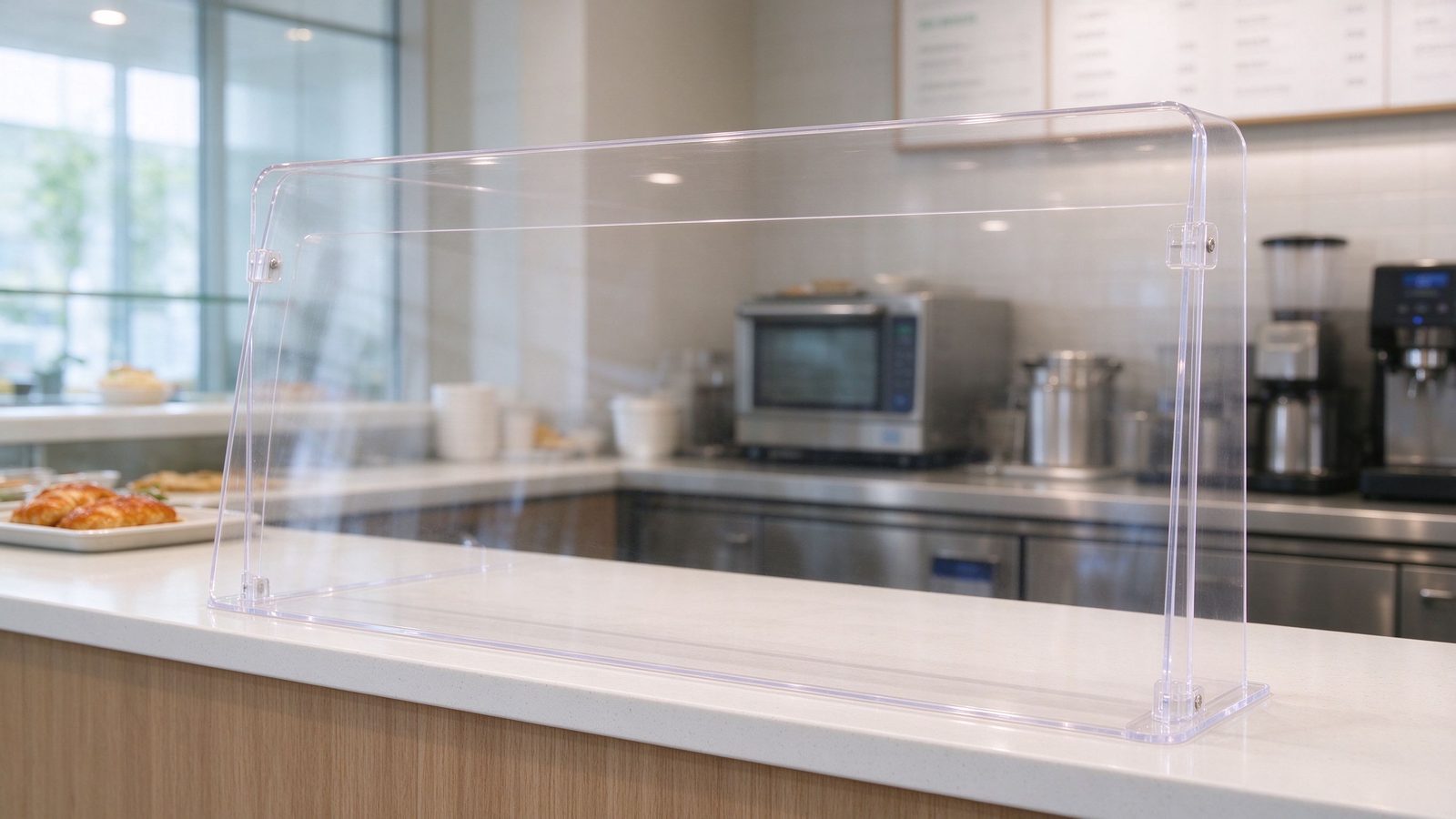
A regional bank in the Netherlands replaced 22 teller positions over a single weekend, and the specification that decided the project was not the panel size or the colour. It was the gap: 40 mm between the counter and the bottom edge of the acrylic bank counter screen, so that a pass-through tray and a document could move without the panel being lifted.
Starting the acrylic bank counter screen from the transaction
A teller screen has four functional zones: the speech aperture, the document and cash pass-through, the card reader reach, and the signature area. Design those first, in that order, then draw the panel around them. Most failed installations began with a panel drawing and tried to fit the transaction into it.
The gap under the panel is the cheapest solution for the pass-through, and it also stops the screen from acting as a lever against the counter when someone leans on it. 30 to 50 mm is the working range.
Panel thickness and how it is held
- 6 mm where the panel sits inside a frame on four edges
- 8 mm for a free-standing screen with two posts
- 10 mm for openings wider than 1.2 m with posts at the ends only
- Edge distance for fixings at least 2.5 times the hole diameter
- 2 mm clearance per metre against metal frames for thermal movement
A teller screen is handled constantly: wiped, leaned against, knocked by a tray. That is a fatigue load, not an impact load, which is why edge distance and clearance matter more than thickness in most failures we see.
The speech aperture, done properly
A 150 x 100 mm aperture with a radiused corner and a small acoustic hood behind it carries a normal conversation at counter distance. Cutting it as a plain rectangle is the fastest way to start a crack, because a sharp corner in cast acrylic is a stress riser.
Where an intercom is fitted, no aperture is needed and the panel stays sealed, which is the better answer in a high-traffic branch. Decide that early; retrofitting an aperture into installed screens is expensive and always looks like a retrofit.
Glare, privacy and the visual brief
Clear cast acrylic at 8 mm transmits around 92 per cent of visible light, which is bright for a lobby with south glazing. A light bronze or grey tint at the same thickness drops transmission ten to twenty points and makes the screen read as architecture rather than as an afterthought.
Anti-glare is a surface question, not a colour question. A lightly textured face scatters reflections; a hard-coated face resists scratching from rings and keys. Ask which face is coated before you approve a sample.
Installation, cleaning and handover
Screens are installed after the counter is level and before the final clean. Fixings go into the counter with an elastomer washer, never directly against acrylic, and the panel is never used to pull the counter into alignment.
Cleaning is the long-term risk. Neutral detergent, soft cloth, no alcohol, no ammonia, no dry wiping. Write it into the handover pack, because a branch cleaning contractor will otherwise use glass cleaner and the panel will craze within months. The cleaning and maintenance guide sets out what is safe on cast acrylic.
Where the screen is part of a clinical or enclosed counter, the detailing overlaps with acrylic medical device enclosures, particularly on sealed joints and cleanability.
For a rollout, order the panels as a schedule rather than as individual pieces: desk number, width, height, aperture position, tint and fixing side. That schedule is what makes an overnight refit possible.
Send your branch layout, desk count and audio requirement to oversales@rpplexiglass.com for a panel schedule and a fixed delivery date.
Frequently Asked Questions
How thick should a teller screen be?
8 mm cast acrylic is the working default for a free-standing teller screen; 6 mm is adequate where the panel is fully framed, and 10 mm is used for wide openings without intermediate posts.
Does acrylic block sound enough for a conversation?
No, and it is not meant to. Teller audio runs through a dedicated aperture or an intercom. Trying to solve speech with a thinner panel produces a screen that flexes and a conversation that still fails.
Will daily cleaning cloud the panel?
Not with neutral detergent and a soft cloth. Clouding comes from alcohol, ammonia or abrasive pads, and from dry wiping that drags dust across the surface. Specify a cleaning protocol at handover and the panel stays clear for years.