
The complaint we hear about an acrylic cuvette rack is never about the rack itself. It arrives as a photo of a scratched cell, a note that a reading drifted, and the question of whether the cells were at fault. Nine times in ten the pocket bore is the cause.
A spectrophotometer cell is a precision optical part with two faces that must stay unmarked. The rack that holds it between readings is therefore a metrology fixture, not a piece of lab furniture, and it should be specified as one.
Pocket bore, chamfer and the acrylic cuvette rack grip
- Body: 5 mm cast acrylic, machined flat to 0.2 mm over 200 mm
- Pocket: 12.5 mm reamed bore for a 12.5 mm square cell
- Depth stop: 8 mm shoulder so the cell sits at a repeatable height
- Mouth: 0.5 mm chamfer, hand deburred
- Finish: frosted on the top face, clear on the sides
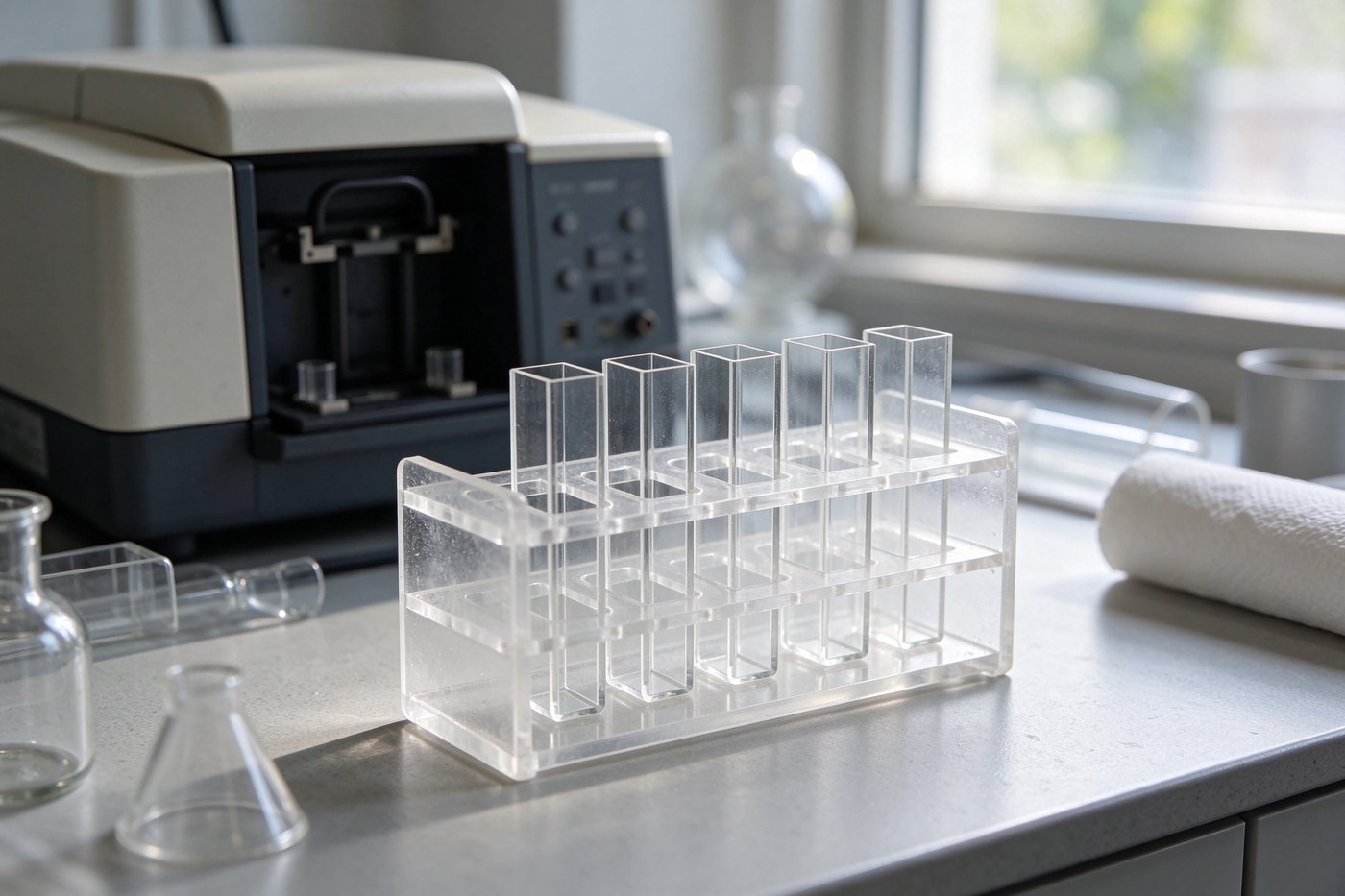
A reamed bore holds a cell on four lines of contact and lets it drop with its own weight. A drilled hole holds on the drill margin, which is a sharp interrupted edge, and that edge is what produces the scratch a customer photographs. The chamfer matters for the same reason: it guides the cell in instead of letting a corner catch the lip.
Where the acrylic cuvette rack sits in a reading sequence
The rack earns its place by shortening the path between the analyser and the next sample. A bench that runs 40 readings in a session does not want a technician turning to a box each time. Pockets at 18 mm centres fit a 6 by 4 layout within 130 mm, which is about the width of a forearm and keeps the rack inside the working zone.
Cleaning and the acrylic cuvette rack lifetime
Cuvettes are rinsed with solvent, and solvent reaches the rack. Cast acrylic tolerates ethanol, isopropanol and dilute detergent. It does not tolerate acetone, MEK or toluene, all of which will craze a pocket wall within minutes. Labs that run acetone rinses should take the rack out of the fume-hood workflow and wipe it separately, or specify a different material.
A batch of cells that cost more than the rack is the reason to get this right. Send the cell format and the analyser model, and we will return a pocket drawing for sign-off.
Tell us the cell format, pocket count and analyser model and we will quote an acrylic cuvette rack against a drawing at oversales@rpplexiglass.com.
Where a method needs tubes as well as cells, the rack should match the tube format rather than the instrument, and the bore rules above apply unchanged. acrylic test tube racks for the same bench covers that part of the specification.
Frequently Asked Questions
Will the rack scratch optical faces?
Not if pockets are 12.5 mm bores reamed rather than drilled, with a 0.5 mm chamfer at the mouth. A drilled 12 mm hole with a sharp lip is what marks a cell on the first insertion.
Why frosted and not clear?
Frosted hides the fine scratches that appear on a rack over a year of use, and it diffuses bench light so a cell is easier to see. Clear is chosen only when a lab wants to check liquid level through the wall.
Can the rack be made for 1 mm path cells?
Yes, with a narrower pocket and a removable insert. Cells under 5 mm path are usually handled in a separate tray because they tip in a wide bore.