
An acrylic petri dish rack decides how quickly a microbiology bench clears after a run, and it is usually the last item anyone specifies. Plates arrive from the incubator warm, lids fogged, and a technician stacks them by hand on whatever surface is free. Two hours later the stack has slid, one lid is cracked, and a sample has to be re-plated.
What follows is the specification sheet we send to labs that ask for a rack, in the order the numbers actually get decided.
Slot pitch and the acrylic petri dish rack footprint
- Plate size: 90 mm standard, 65 mm for contact plates, 140 mm for square plates
- Slot pitch: 12 mm for 90 mm plates, 14 mm where lids are thick walled
- Tier depth: 250 mm carries 20 to 25 plates, 300 mm carries 30
- Material: 5 mm cast acrylic, clear, both faces masked during cutting
- Base: 8 mm cast foot bar with four silicone pads
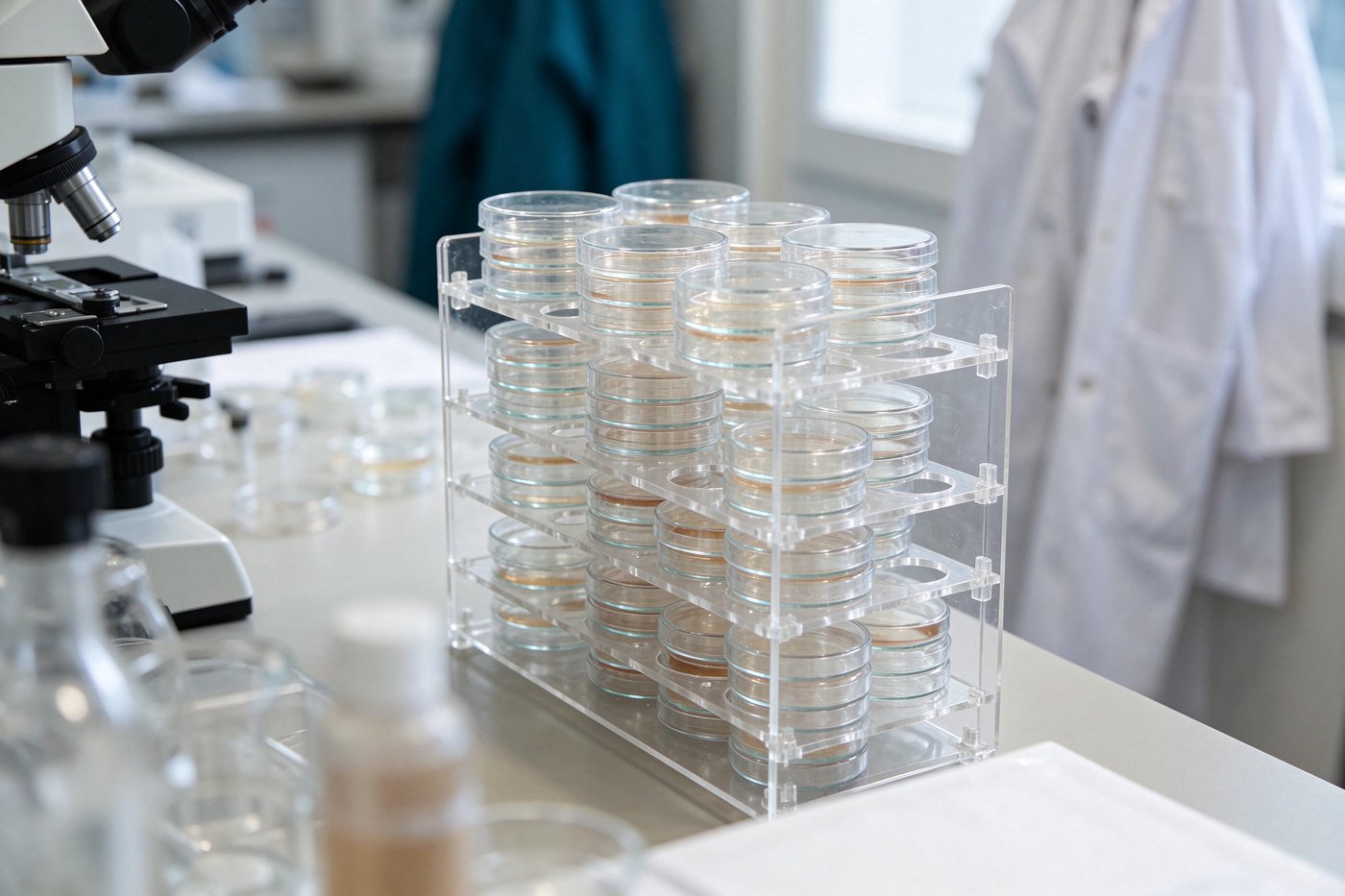
Pitch is the number most labs get wrong. A 90 mm plate with its lid measures roughly 95 mm at the rim, and a 10 mm pitch looks efficient on a drawing until the first technician tries to slide a plate in with gloves on. Twelve millimetres leaves a finger gap and gives condensate a channel to drain down instead of sitting between plates.
Heat, condensate and the acrylic petri dish rack limits
Cast acrylic softens around 80 C. An autoclave cycle at 121 C will not just warp a rack, it will relieve the internal stresses from machining and leave the slots visibly bowed. Labs that need a sterilisable carrier should specify polypropylene or stainless and accept the weight. For acrylic, cleaning means alcohol wipe or a mild detergent at room temperature, and the rack should be dry before plates go back in.
Drainage and stacking detail
Each slot floor gets a 6 mm drain hole on a 40 mm grid. Without them, condensate from a warm plate collects in the slot and the next plate sits in water, which is exactly the condition that spreads contamination across a stack. Tiers are joined by 8 mm cast side cheeks with a 20 mm stacking spigot, so a second rack locates on the first without sliding when a bench is moved.
Edges are flame polished on the front and left sawn at the back, because the back sits against the wall and a polished edge there buys nothing. Every rack leaves with a drawing, and a sample tier can be sent before a lab commits to a full bench fit.
Send the plate diameter, tier count and bench depth to oversales@rpplexiglass.com for a drawing and a price per rack.
Benches that also run cultures usually want plate storage and vessel storage specified together, and the same sheet thickness logic carries over. acrylic tissue culture vessels for suspension work covers that part of the specification.
Frequently Asked Questions
Can the rack go through an autoclave?
No. Cast acrylic softens near 80 C and distorts well before a 121 C cycle finishes. Racks are cleaned with alcohol or a mild detergent; plates are sterilised before they are loaded, not in the rack.
Why 12 mm slot pitch and not tighter?
A 90 mm plate with a lid measures about 95 mm across the rim. At 12 mm pitch a full stack still leaves finger clearance, and condensate has a path down the slot instead of pooling between plates.
Is 5 mm enough for a full tier?
Yes for 20 to 25 plates per shelf at 250 mm depth. Two side rails carry the load, so the panel only resists bowing between slots, which is a short span.