
An acrylic dog gate panel fails at its fixings long before the sheet gives way.
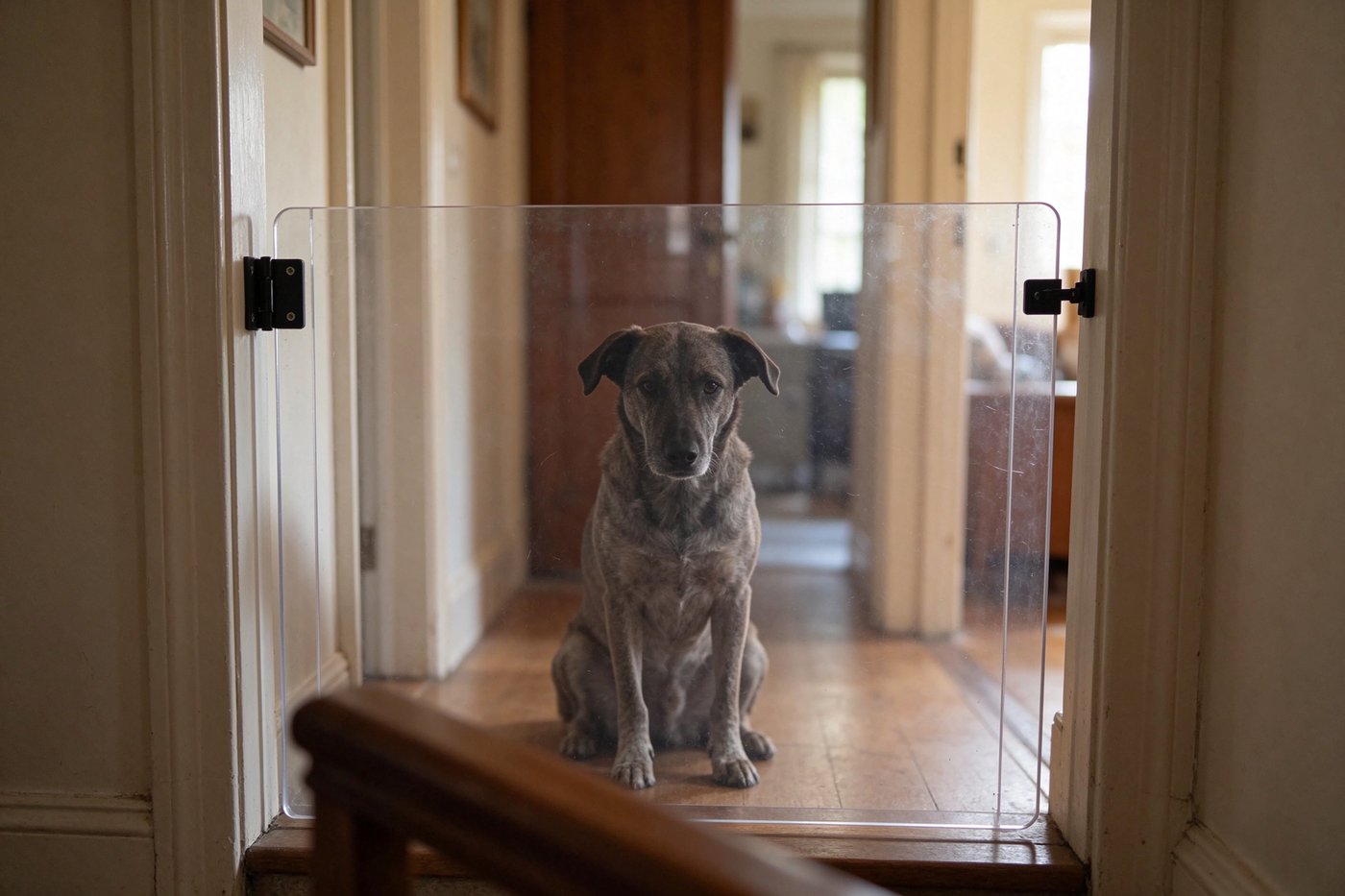
A three-panel indoor dog gate came back from a customer in Manchester with a crack running 22 mm from the top hinge screw. The sheet was 6 mm cast, the hinge was a standard cabinet hinge, and the screws had been driven in with a cordless driver until the head touched the surface. The gate itself was well made. The panel had been treated as a piece of glass with holes in it, and that is where the failure started.
An acrylic dog gate panel is a moving part. It swings, it gets leaned on, and a dog pushes against the lower half with its chest. The sheet therefore has to be sized for bending, and every hole has to sit far enough from an edge that the stress around the fastener stays inside the material instead of running to the nearest free edge.
Sizing the panel before the frame
For a hallway gate in a domestic setting, 8 mm cast acrylic is the practical starting point, with 6 mm only where the opening is under about 800 mm wide and the gate is not leaned on. Height is driven by the animal: around 750 mm clear panel for a dog that jumps, 900 mm where the dog is a known climber. Above 1,000 mm the panel becomes a sail, and a gate that size needs a frame rather than a clamped edge.
Width matters more than people expect. A 900 mm wide panel at 8 mm deflects visibly under a 25 kg dog pushing at the centre. Either narrow the leaf or add a mid-rail. Splitting the opening into two 600 mm leaves is usually cheaper than going to 10 mm sheet and a heavier hinge set.
Holes, clamps and the detail that keeps the sheet alive
- Hinge and latch holes no closer than 2.5 times the panel thickness from any edge, and never in line with a saw-cut edge that has not been polished
- Drill with a brad-point or step bit at low speed, back the exit face with a scrap block, and clear the flutes every few millimetres
- Clamp the panel in a U-channel or a pair of polished plates rather than hanging it on screws alone; the clamp spreads the load over 60 to 100 mm of edge
- Leave 1.5 to 2 mm of clearance in every hole for thermal movement, and use a washer with a rubber face on both sides
The Manchester gate was fixed by moving the hinge holes in 18 mm, polishing the edges, and adding an aluminium U-channel to the top and bottom edges. The replacement panel has run for two years without a mark. The original failure cost more in rework than the channel would have cost at the start.
Cleaning and the everyday wear nobody plans for
A gate is touched far more often than a window. Fingerprints, nose marks and spray cleaner all land on the same 300 mm of surface. Cast acrylic tolerates mild soap and water; ammonia-based glass cleaner and alcohol wipes will craze it within months. Specify a plain soap spray and a microfibre cloth, and keep abrasive pads away from the panel.
RP River People Plexiglass cuts dog gate panels to a paper template, polishes all edges, drills the hinge pattern to the customer drawing and ships them interleaved with foam. Send the gate frame dimensions and we will quote the panel with the clamp detail included.
Send the gate frame drawing and panel height to oversales@rpplexiglass.com and we will return a cut-to-template quotation with the clamp detail priced separately.
Gates are usually ordered from a template rather than a stock sheet, and the tolerance and edge rules in our acrylic cut-to-size note apply to every panel described here.
Frequently Asked Questions
Can an acrylic dog gate panel be drilled at home?
It can, but the drill matters more than the panel. Use a brad-point bit, low speed, no pressure at the exit, and a backing block. Cracks almost always start at the exit hole or at a hole drilled too close to an unpolished edge.
Why 8 mm rather than 6 mm?
Six millimetre sheet is fine for a narrow leaf that nobody leans on. On a 900 mm gate with a jumping dog the deflection becomes visible and the hinge holes work loose. Eight millimetre keeps the panel stiff enough for a domestic hallway without going to a frame.
Will the panel yellow indoors?
Standard cast acrylic is stable indoors. Near a south-facing patio door the UV load rises, and a UV-filtering grade is worth specifying if the gate sits in direct sun for hours.