
A toll-road maintenance team in a subtropical climate sent us six cracked panels from a 4.2 km sound wall. The acrylic had not gone cloudy and the measured reduction was still on target. What failed was every panel at the fixing holes.
What the wall was built with
The barrier used 15 mm clear cast acrylic, 2,000 mm wide by 4,500 mm high, mounted between galvanised H-posts at 4,000 mm centres. Target reduction was Rw 30 dB for the residential side. That specification is normal for a road of this class, and acoustically it worked.
The failure was thermal. Cast acrylic moves roughly 0.065 mm per metre per degree Celsius, eight times more than glass. Over a 1,000 mm panel width and a 45 °C annual swing, the panel grows and shrinks about 3 mm against a rigid 4,000 mm steel frame. The original drawings had 12 mm holes for M10 bolts, leaving 1 mm of clearance each side — less than the movement.
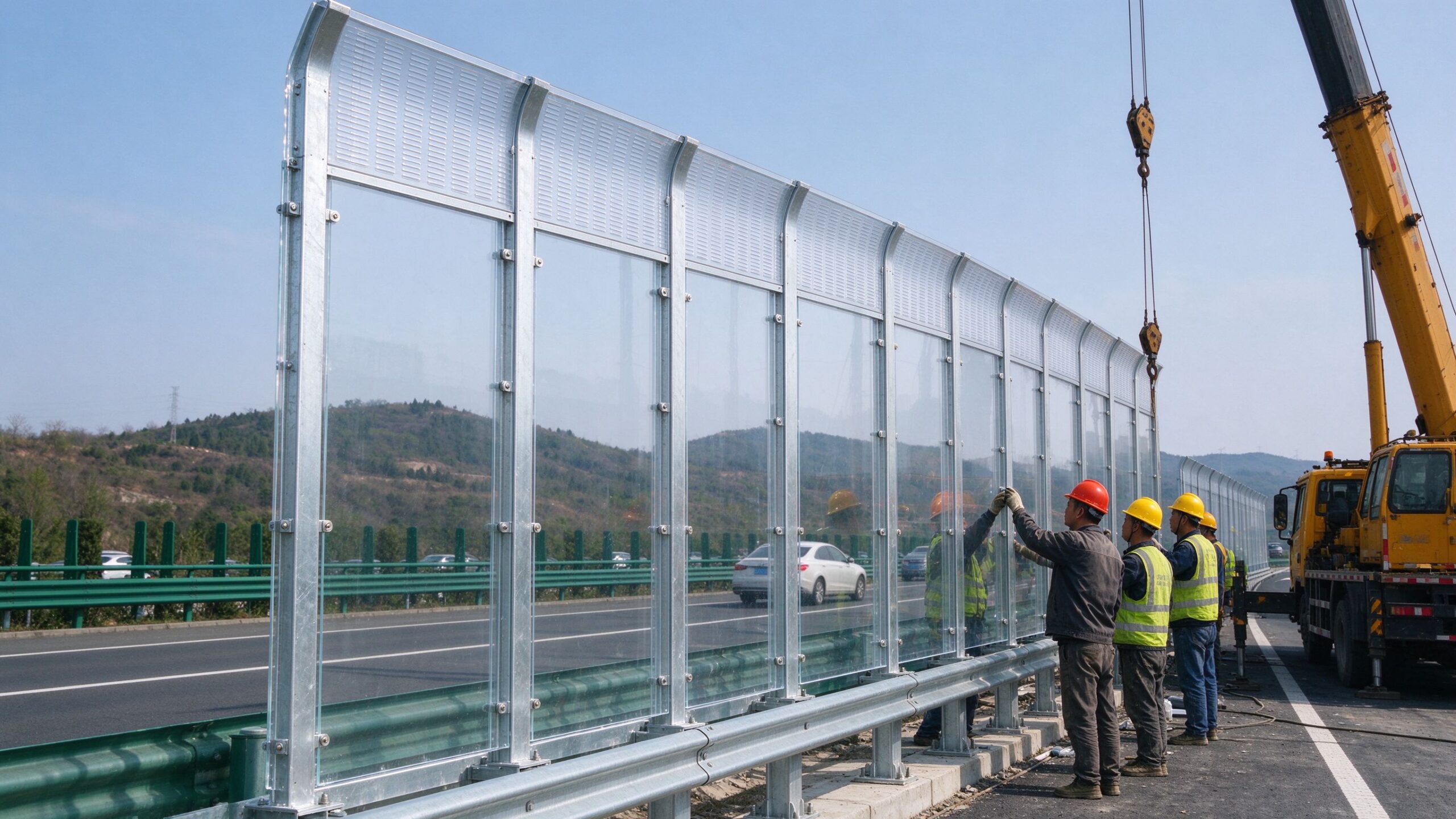
What we changed on the replacement run
- Holes opened to 18 mm for M10, a 4 mm radial allowance at each fixing.
- EPDM-backed washers and a 3 mm closed-cell gasket so the panel never bears on bare steel.
- Panel width trimmed from 2,000 mm to 1,900 mm, moving 100 mm of movement into the joint instead of the hole.
- Neutral-cure silicone in the vertical joints, specified for acrylic rather than general-purpose glazing sealant.
- Bottom edge raised 15 mm off the sill so water drains instead of sitting at the panel foot.
On the rebuilt section the panels have run through two full summers without a new crack. Reduction stayed at Rw 30–31 dB, and light transmission was unchanged.
Numbers worth checking before you drill
For a transparent road wall, 15 mm is common up to about 4 m of exposed height and 20 mm above that or where wind load is high. Drilling allowance should be at least twice the expected thermal movement, and never under 3 mm radial clearance for M10. Fixings should be at 300–400 mm centres vertically, not 600 mm, so the panel does not bow between bolts.
Panel fabrication and drilling tolerances for this kind of wall are covered in our note on transparent noise barrier panels with test reports, and the wind-load case for exposed structures is set out in bridge wind barrier acrylic.
Frequently Asked Questions
Q: Why do acrylic highway barrier panels crack at the bolt holes?
A:Because the hole has less clearance than the panel’s thermal movement. Cast acrylic expands about 0.065 mm per metre per degree Celsius, so a 1,000 mm panel in a 45 °C swing moves roughly 3 mm. A 12 mm hole for an M10 bolt leaves only 1 mm each side and the panel splits at the fixing. Open the holes to 16–18 mm and add a gasket.
Q: What thickness is used for a transparent highway sound wall?
A:15 mm cast acrylic is typical up to roughly 4 m of exposed height, and 20 mm above that or where wind load is high. Both give around Rw 30–31 dB in a plain transparent panel, with edge sealing and correct post spacing doing as much work as the extra thickness.
Send your sound-wall drawings, span between posts and required Rw to oversales@rpplexiglass.com for a cast acrylic panel quotation with drilling and edge details.