
A chilled distributor in Rotterdam changed tray suppliers after a pallet of frozen product arrived with 60 cracked units. The trays had passed a room-temperature drop test. The petg cold chain tray that replaced them was thermoformed from 1.0 mm sheet with a shallower draw and was validated at minus 25 before the first production run.
Validation protocol for a petg cold chain tray
The protocol has four stages, and each one eliminates a different failure mode. Skipping the cold stage is the most common reason a tray passes in the lab and fails in a freezer aisle.
- Stage 1, material: 1.0 mm PETG sheet with a food-contact declaration and a glass transition well below service temperature.
- Stage 2, form: draw ratio under 2.5 to 1, wall thickness at the corners checked by sectioning.
- Stage 3, cold drop: 1.2 m drop at minus 25, six orientations, ten samples.
- Stage 4, stack: 24-hour load at 8 kg per tray at minus 18, checking for creep and nesting lock.
Why the draw ratio decides cold performance
PETG is amorphous, so it thins predictably at a draw, but a deep draw leaves 0.4 mm walls at the base corners where impact stress concentrates. A tray drawn 120 mm deep from 1.0 mm sheet at a 2.5 ratio holds around 0.55 mm at the corner; the same tray at a 3.2 ratio drops below 0.4 mm and cracks on the first cold drop.
The fix is not thicker sheet by default. A shallower tray or a corner radius of at least 8 mm restores wall thickness at a lower material cost.
Sealing and condensation in a cold chain
A sealed PETG tray with a lidding film traps moisture, and condensation on the inside face is normal. What matters is that the film seal survives the temperature swing: a seal validated at 20 degrees often leaks at minus 18. Seal strength should be tested after a freeze cycle, not before.
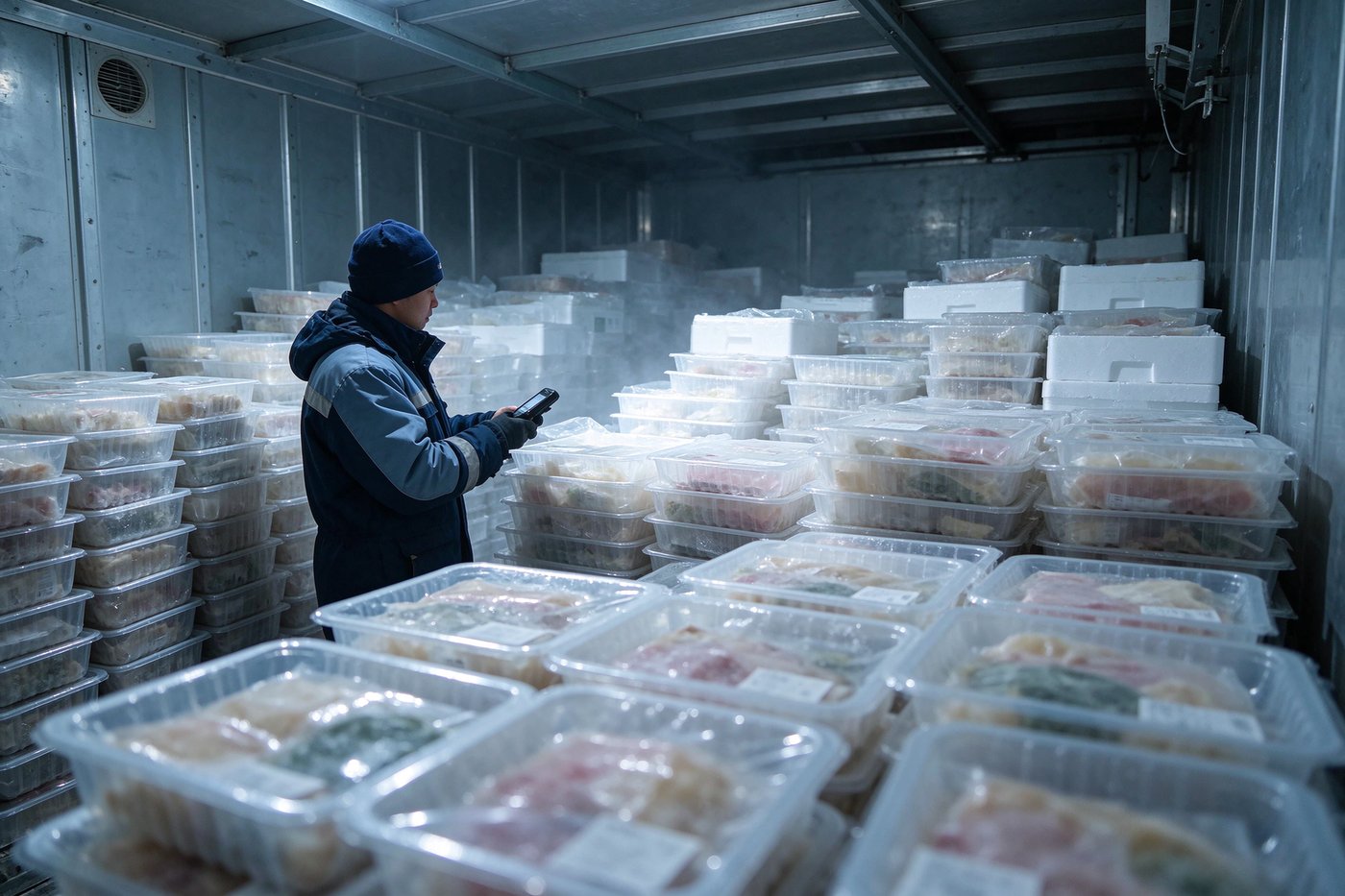
River People capability
River People thermoforms PETG trays from 0.8 to 1.5 mm sheet, with draw ratios and corner radii set from the validation plan rather than the mould shop default. Food-contact documentation is supplied per batch, and tooling for a new tray geometry takes about three weeks.
Send your tray dimensions and cold-chain profile to oversales@rpplexiglass.com for a forming and validation plan.
Medical trays face comparable temperature swings, and the PETG sterilization tray guide covers the autoclave side of the same material.
Frequently Asked Questions
Is PETG suitable for blast freezing?
For short blast freezing at minus 30 to minus 35, a properly drawn 1.0 mm tray works if the drop test is run at that temperature. Long-term storage below minus 40 calls for a different material.
Can the tray be microwaved?
PETG softens around 70 to 80 degrees, so it is not suitable for microwave reheating. It is a chill and ambient distribution material.
What food-contact documents should I ask for?
A declaration of compliance with EU 10/2011 or FDA 21 CFR 177.1315, plus the migration test summary for the intended fat and acid content.