
A polycarbonate batting cage panel fails at a screw hole long before it fails at the sheet.
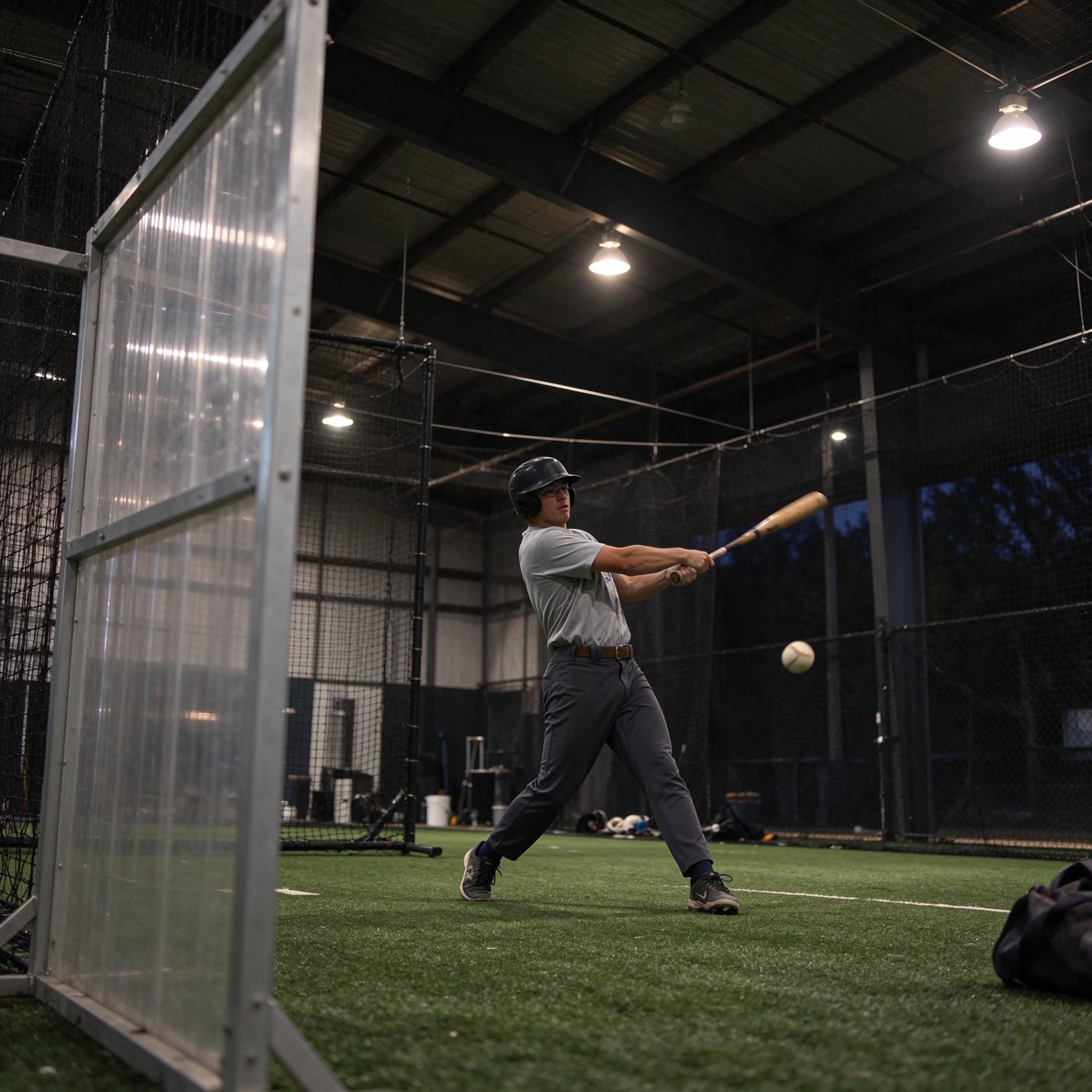
A batting cage in Sheffield replaced its netting with polycarbonate after two seasons of repairs, and the first panel failed in eleven days. The installers had fixed 6 mm sheet to a steel frame with self-drilling screws straight through the panel at 200 mm centres, and a 90 mph ball off a bat found the first screw hole.
Ball energy versus fixing detail
A 5 oz baseball at 90 mph carries about 260 J. A 6 mm polycarbonate panel will absorb that repeatedly without cracking, provided the panel is free to deflect. What it will not survive is a screw hole: a hole is a stress riser, and the same impact that dents a free panel will start a radial crack at a clamped hole.
The workable fixing is a clamping bar: a 40 mm aluminium flat bar over the panel edge, bolted to the frame, with the polycarbonate resting on a 3 mm EPDM gasket. The panel is held, not pierced. Where a pierced fixing is unavoidable, use a 12 mm clearance hole with a rubber-backed washer and never place a hole within 75 mm of the panel edge.
Polycarbonate batting cage panel: thickness, span and mounting
- Thickness: 6 mm for impact speeds up to about 90 mph at a 1200 mm unsupported span; 8 mm above that or where the span exceeds 1500 mm.
- Edge clearance: 5 mm at each side for thermal movement; polycarbonate grows about 0.4 percent across a 40 C swing.
- Fastening: aluminium clamp bar and EPDM gasket; clearance holes 12 mm with washers only where clamping is impossible.
- Frame: steel at 1200 mm centres; the panel is not a structural member and must not brace the frame.
- Replacement: individual panels, so a damaged bay can be swapped without dismantling the cage.
Eleven days, then a season without a failure
The Sheffield rebuild went to 8 mm sheet in 1500 by 1200 mm bays, clamped at the edges with 40 mm bars and gaskets, and set 5 mm clear in each rebate. Over the following season, with junior and adult batting at up to 95 mph, no panel cracked. Two panels took scuff marks from bat follow-through and were left in place.
The operator also removed the netting behind the polycarbonate in the front bay. The combination of net and sheet had been catching balls between the layers, and the trapped ball was delivering a second impact to an already loaded panel.
Where the cage is outdoors, the sheet needs a UV-stabilised grade and a 100 mm gap from any netting, so airflow dries both surfaces. Polycarbonate that stays wet against a net grows a biofilm that looks like a defect in the sheet.
Sizing a cage bay around the panel
Measure the frame centres, the largest bay height, the ball speed the cage is rated for and whether the sheet replaces or backs up netting. Thickness and clamping follow from those four. River People PLEXIGLASS supplies UV-stabilised polycarbonate sheet from 4 mm to 12 mm, cut to bay size with 5 mm clearance allowance, and can supply the clamp bars and gaskets with the panels. Send the bay dimensions and ball speed and we will quote the panels, bars and packing.
Send bay dimensions, frame centres and the ball speed the cage is rated for, and we will quote panels, clamp bars and gaskets: oversales@rpplexiglass.com.
Repeated puck and ball impacts raise identical fixing questions, set out in our rink shielding guide.
Frequently Asked Questions
What thickness of polycarbonate stops baseballs in a batting cage?
Six millimetre handles repeated 90 mph impacts at a 1200 mm span. Use 8 mm above 90 mph or where the unsupported span exceeds 1500 mm, and always clamp the panel rather than screwing through it.
Why did the polycarbonate crack at the screws?
A pierced fixing is a stress riser. The same impact that a free panel absorbs will start a radial crack at a clamped hole, so the panel has to be held by a clamp bar over a gasket, not drilled and screwed.
How much clearance does a polycarbonate cage panel need?
About 5 mm at each edge. Polycarbonate expands roughly 0.4 percent across a 40 C swing, which is 6 mm on a 1500 mm panel; clamped tight, that movement buckles the sheet or pulls the fixings.