
A polycarbonate go-kart chain guard has to cover the tangent a snapped chain follows, not just the chain run.
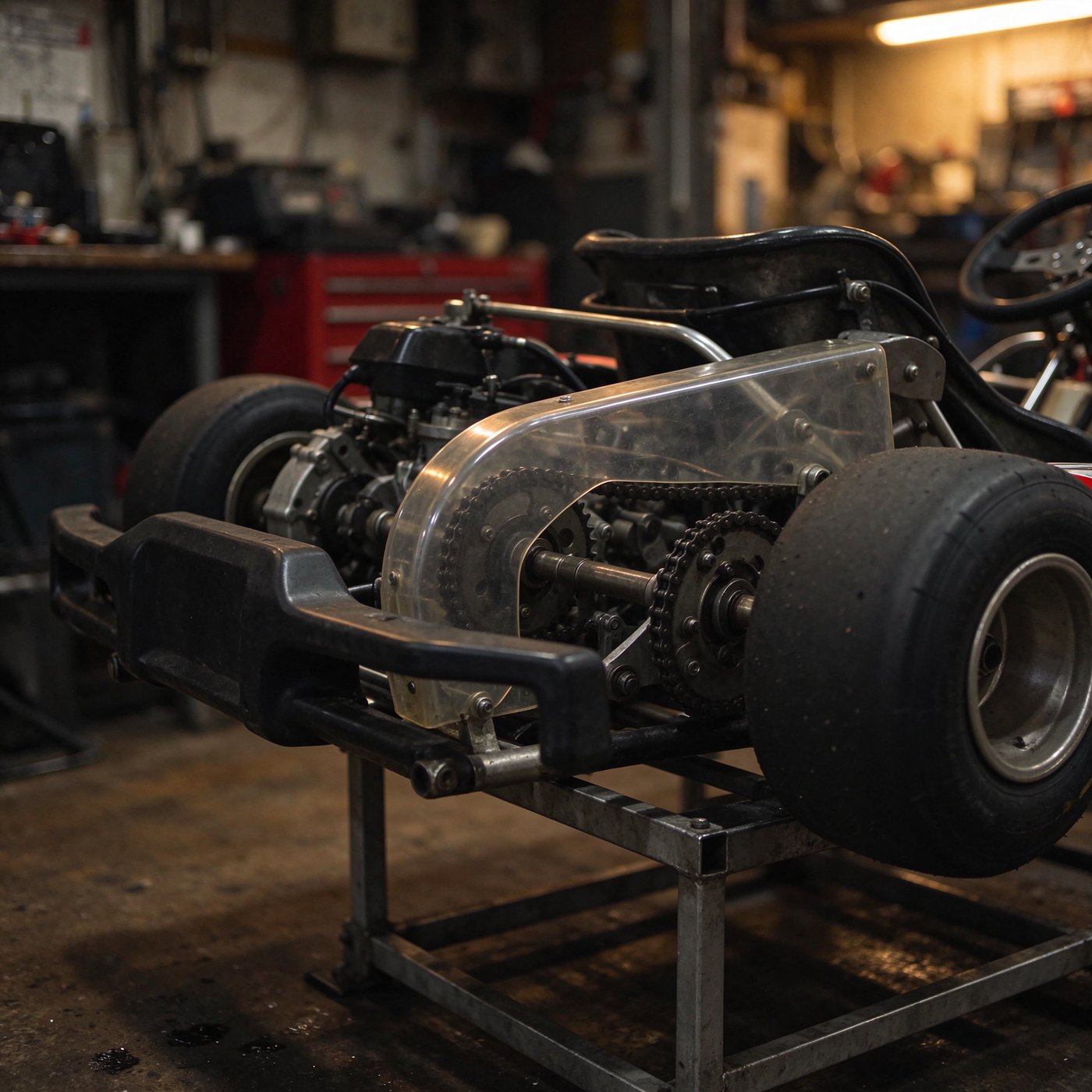
A kart circuit near Rye had two chain failures in one race meeting and both threw a length of chain through the plastic guard that came with the karts. The guards were 3 mm polycarbonate, bolted at four corners, and the chain exited through the fixing line rather than through the sheet.
The chain leaves along the tangent, so the guard has to cover it
When a 428 chain snaps at 6000 rpm on a 40 tooth rear sprocket, the free end travels at roughly 30 m/s along the tangent of the sprocket. That tangent line runs forward and upward from the top of the sprocket, and it is exactly the area a small four-corner guard tends to leave open. The guard has to cover from 10 o clock to 2 o clock around the sprocket, not just the chain run.
Five millimetre polycarbonate is the practical thickness. It absorbs a chain strike by deforming, and it will hold the chain inside the guard if the guard is continuous around the tangent. Three millimetre sheet will also deform but tears at the bolt holes under the same load, which is what happened at Rye.
Polycarbonate go-kart chain guard: geometry and fixing
- Coverage: from 10 o clock over the top to 2 o clock, plus 60 mm either side of the chain line.
- Thickness: 5 mm polycarbonate; 6 mm where the guard is also the driver barrier.
- Clearance: 15 mm minimum between chain and guard at the tightest point, checked with the chain tensioned.
- Fixings: 8 mm clearance holes with rubber-backed washers, 30 mm from any edge and never on the tangent line.
- Drainage: a 10 mm slot at the lowest point so oil and water do not pool against the chain.
Rye, and a guard that became a containment box
The rebuild replaced the four-corner guards with a three-sided box: 5 mm front face, 5 mm top, and a 3 mm rear deflector, all bolted to a steel subframe rather than to the kart chassis. Coverage ran from 10 o clock to 2 o clock, with 60 mm of margin each side of the chain line.
The second change was inspection. A 40 mm hole with a rubber plug was added at the sprocket centre line, so a mechanic can check chain tension and wear without removing the guard. Before that, guards were being left off after a chain adjustment, which is how two karts raced without one.
The circuit also moved from 3 mm to 5 mm sheet on all twelve karts and standardised the bolt pattern, so a spare guard fits any kart in the fleet.
Why a polycarbonate guard and not aluminium
An aluminium guard contains a chain better and weighs three times as much on a 100 kg kart. It also transmits the strike into the chassis and, on a wet track, becomes an oil-slick surface. Polycarbonate gives the containment with a 1.2 kg guard, and a deformed guard that has done its job can be seen at a glance rather than measured.
The material does have a service life. Five millimetre polycarbonate that has taken a chain strike should be replaced, not straightened, because the impact leaves the sheet locally thinner and crazed. Keeping a spare guard per two karts is cheaper than a DNF.
Send the sprocket diameter, chain pitch, kart chassis mounting points and whether the guard doubles as a driver barrier. River People PLEXIGLASS cuts 5 mm and 6 mm polycarbonate guards to a drawing, drills clearance holes to your pattern and can supply the steel subframe brackets. Send the sprocket and chassis details and we will quote the guards and the bracket set.
Send sprocket diameter, chain pitch and chassis mounting points and we will quote 5 mm guards with drilled clearance holes and brackets: oversales@rpplexiglass.com.
Small fast vehicles share the same vibration and debris problem, covered in our motorcycle windshield guide.
Frequently Asked Questions
What thickness polycarbonate should a go-kart chain guard be?
Five millimetre for a 428 chain at racing speed, 6 mm where the guard also acts as a driver barrier. Three millimetre sheet deforms but tears at the bolt holes when a chain lets go.
How much of the sprocket should the guard cover?
From 10 o clock over the top to 2 o clock, plus 60 mm each side of the chain line. A snapped chain leaves along the tangent, and a guard that stops at the chain run leaves that path open.
Can a guard that took a chain strike be reused?
No. The impact leaves the polycarbonate locally thinner and crazed, so it will fail at a lower load next time. Replace it and keep a spare per two karts.