
A polycarbonate treadmill belt guard sits on a machine that vibrates all day.
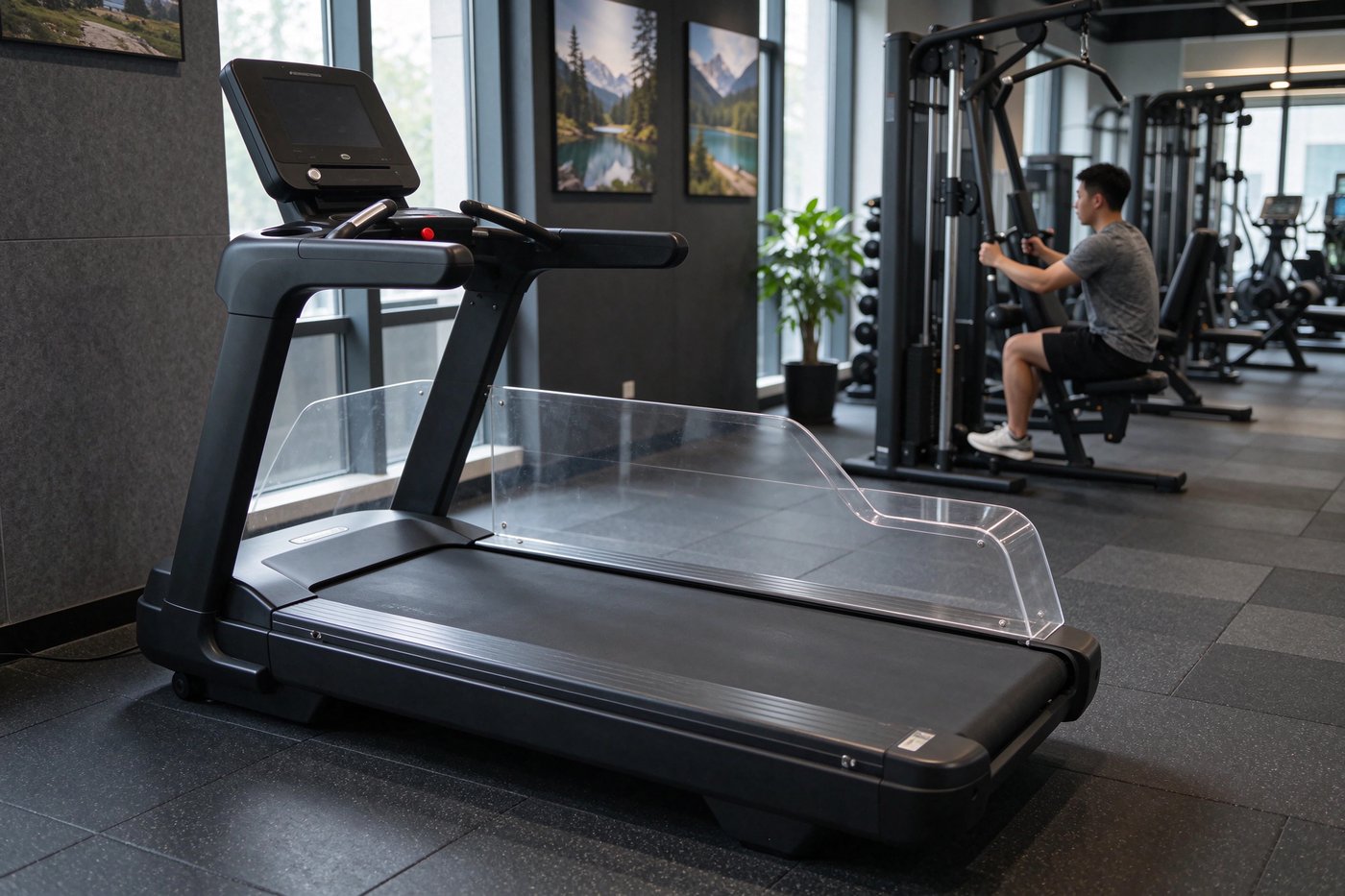
A gym chain refurbished 60 treadmills with clear guards bought as a generic part. Within a month, 14 had cracked at the rear roller cover and two had been removed by staff because they rattled. The panels were 3 mm, held by four self-tapping screws straight into the plastic housing.
A polycarbonate treadmill belt guard sits on a machine that vibrates continuously and gets kicked, leaned on and cleaned twice a day. That is a fatigue environment, not a static one, and the fixing detail decides the service life far more than the thickness.
Gap rules that stop a shoe reaching the belt
The guard has to close the gap between the side rail and the belt to less than 10 mm at any point a toe could reach. On most machines the rear roller and the front motor cover are the two places where a loose shoelace can be caught. Measure both with the guard in place, not on the drawing.
Four millimetre polycarbonate is the usual thickness for a belt-side guard up to 400 mm wide. Three millimetre is enough for a cover that carries no load, but it will drum and rattle on a running machine unless it is supported along its length.
Vibration, screws and the rattle fix
- Use a rubber or EPDM washer under every fastener, and a metal sleeve inside the hole so the panel is not clamped
- Add a support rail along the centre of any panel longer than 300 mm
- Drill holes 2 mm larger than the screw and do not tighten until the panel touches the housing
- Check the guard at running speed before the machine goes back on the floor
The rattle in the gym chain came from panels clamped hard against the plastic housing. Polycarbonate transmits vibration; a clamped panel becomes a drum. A rubber washer and a sleeve isolate it, and the noise disappears without changing the sheet.
Cleaning in a gym, where sanitiser is everywhere
Gym wipes are often alcohol-based, and alcohol is the fastest way to craze polycarbonate. A guard cleaned twice a day with an alcohol wipe will show a fine network of cracks within a year, usually starting around the fastener holes. Specify a mild soap or a quaternary-ammonium wipe, and keep the guard dry where it meets the frame.
RP River People Plexiglass cuts treadmill guards to the machine outline, with slotted or sleeved holes and edge polishing. Send the machine model and a photograph of the open side for a quotation.
Send the treadmill model and photographs of the belt area to oversales@rpplexiglass.com for a cut guard quotation.
Where a guard is wiped daily, the coating matters as much as the thickness, as our hard coated guard sheet note explains.
Frequently Asked Questions
Why does the guard rattle on a running treadmill?
Because it is clamped hard to a vibrating frame and acts as a drum. Rubber washers and a centre support rail stop the noise without changing the panel.
Can I use 3 mm polycarbonate?
For a short cover with no load, yes. On a full belt-side guard longer than 300 mm, 3 mm drums and cracks around the fixings. Four millimetre is the practical choice.
What should the gap to the belt be?
Under 10 mm at any point a toe could reach, checked with the guard fitted. The rear roller and front motor cover are the usual weak spots.