
A five-star resort in the Middle East opened a new lagoon restaurant where diners sit below the water line. The brief was simple and unforgiving: a transparent underwater observation window large enough for a family to gather against, clear enough to watch rays pass, and safe enough that no engineer second-guesses the numbers. That project taught the owner team, and me, exactly how a cast acrylic window is specified when the stakes are structural rather than decorative.
Why the window is not a slab of sheet you cut
An underwater observation window lives under hydrostatic load. The force on the glass grows with water depth, and for a window this size it is measured in tonnes against the pane. Extruded sheet drifts in thickness and carries internal stress that can creep under load. That is why we specify cell cast acrylic for any underwater observation window: cast polymerisation builds the sheet from monomer into one homogeneous block with low internal stress, so it holds dimension, resists crazing and keeps optical clarity for decades.
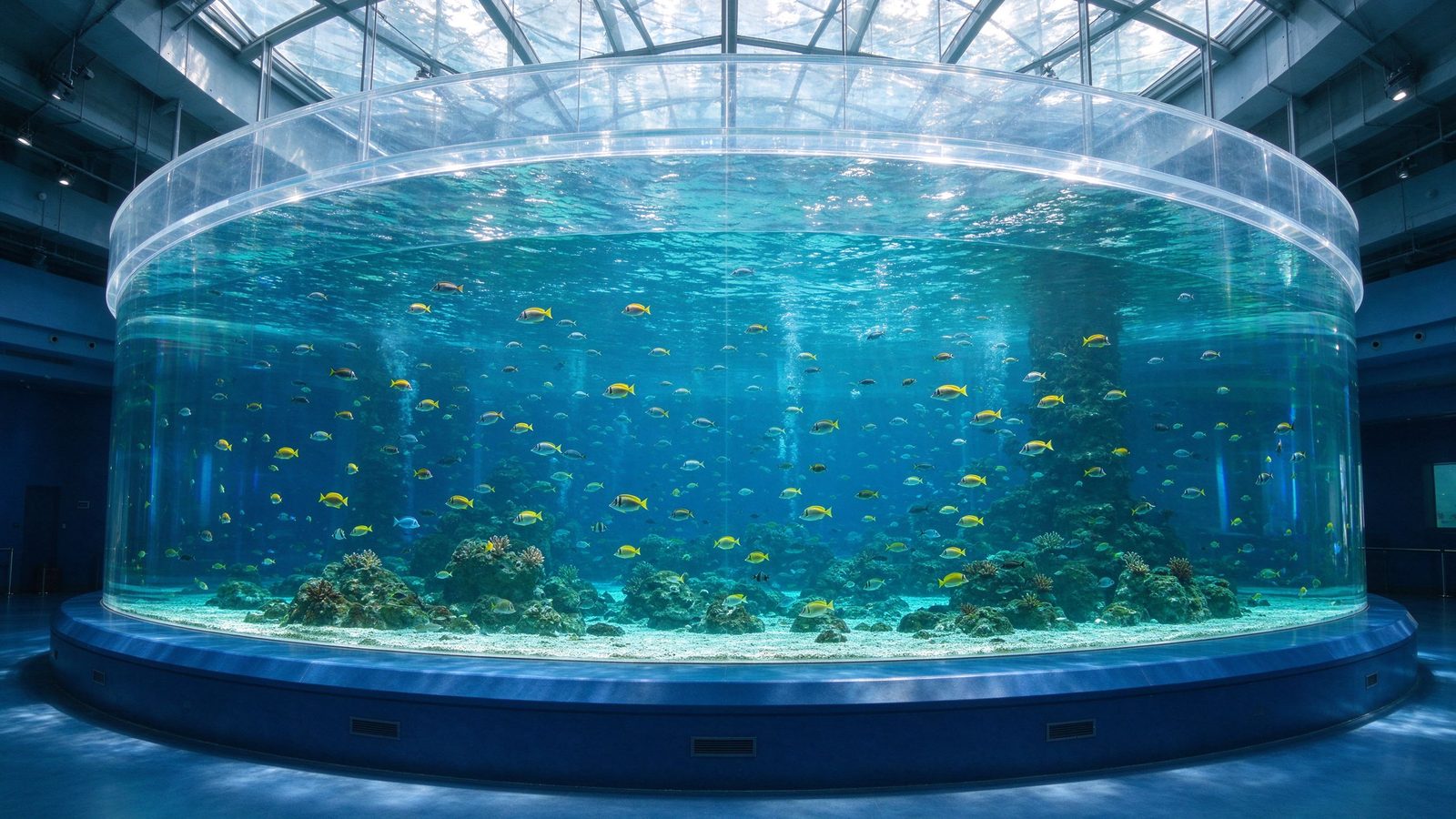
Real numbers from the lagoon project
That resort specified a single pane 2.4 m wide by 1.8 m high, set with its bottom edge 1.6 m below the water surface. With a support frame on all four edges, the governing thickness landed at 50 mm cast acrylic. Had the pane been free-edged or the depth pushed to 3 m, we would have stepped up to 75 mm or 100 mm. Do not fix a thickness from a “one size fits all” table; it is a function of span, depth and edge restraint, and the same opening at 1 m and at 4 m depth wants different panels.
How the panel gets from block to installed window
RP River People casts and machines the panel, then dresses the edges to a true square. The seal sits on a machined face, not on a saw cut, because a compression gasket needs a flat register to hold water. The panel is delivered with edge detail already cut to the frame’s tolerance; on site it is lowered into a pre-formed rebate, bedded on a continuous gasket, and clamped by the frame so the load transfers to the edges rather than to the bolt points.
The failure I see most often is thin glazing chosen to save cost, then a frame that bites the panel through local pressure. Read about the sister discipline of large aquariums in our guide on large acrylic aquarium viewing panels, and on acrylic underwater tunnel sections for the joining logic used on long runs.
Frequently Asked Questions
Q: What thickness do I need for an underwater observation window?
A: It depends on the span, the water depth at the window bottom, and whether the pane is supported on all edges. Typical engineered values run from 30 mm for small shallower windows up to 100 mm and beyond for large deep panels; submit your opening and depth for a calculation.
Q: Can I use glass instead of cast acrylic?
A: Yes, but cast acrylic is roughly half the weight of laminated glass at equal strength, carries lower frame load, and can be machined and bonded into large one-piece panels that glass cannot deliver practically.
Q: How is the window sealed against leakage?
A: A machined edge register is bedded on a continuous gasket and clamped by the frame so that hydrostatic load stays on the edges; the panel itself must not be used as the structural seal.
For a project-specific quotation on cast acrylic panels, email oversales@rpplexiglass.com with your opening size, water depth, support layout and drawing.