
A hotel terrace in Cyprus replaced its acrylic wind screens after four summers. The panels had not broken; they had gone from clear to a warm amber, and against white render the effect read as dirt. The replacement specification was one line longer than the original, and that line was uv resistant acrylic sheet.
Three ways outdoor acrylic actually fails
The first is yellowing, driven by UV exposure and heat together. The second is surface chalking, where the top few microns break down and scatter light, which reads as haze. The third is stress cracking at fixings, where thermal cycling loads a hole that was drilled too close to an edge.
Only the first two are chemistry. The third is detail, and it kills more panels than the sun does.
What uv resistant acrylic sheet must survive outdoors
- Ultraviolet dose at the site, which is altitude and latitude dependent
- Surface temperature swings between day and night, not just peak heat
- Thermal movement against the frame, roughly 5 mm per metre over 40 degrees
- Cleaning chemicals used by the site contractor
- Wind load on an unsupported span
- Hail or grit impact on a horizontal panel
A specification that answers those six is a specification. One that says outdoor grade is a hope.
Absorber loading and what the datasheet should say
UV absorbers in acrylic are measured in tenths of a per cent, and the useful number is the transmission cut-off wavelength, typically quoted around 380 to 400 nm. A sheet that blocks below 360 nm is protecting itself only partially; a sheet that blocks to 400 nm is doing the job.
Ask for the cut-off, not the word UV-stabilised. The difference between two suppliers at the same price is often exactly this number.
Cast, extruded and co-extruded
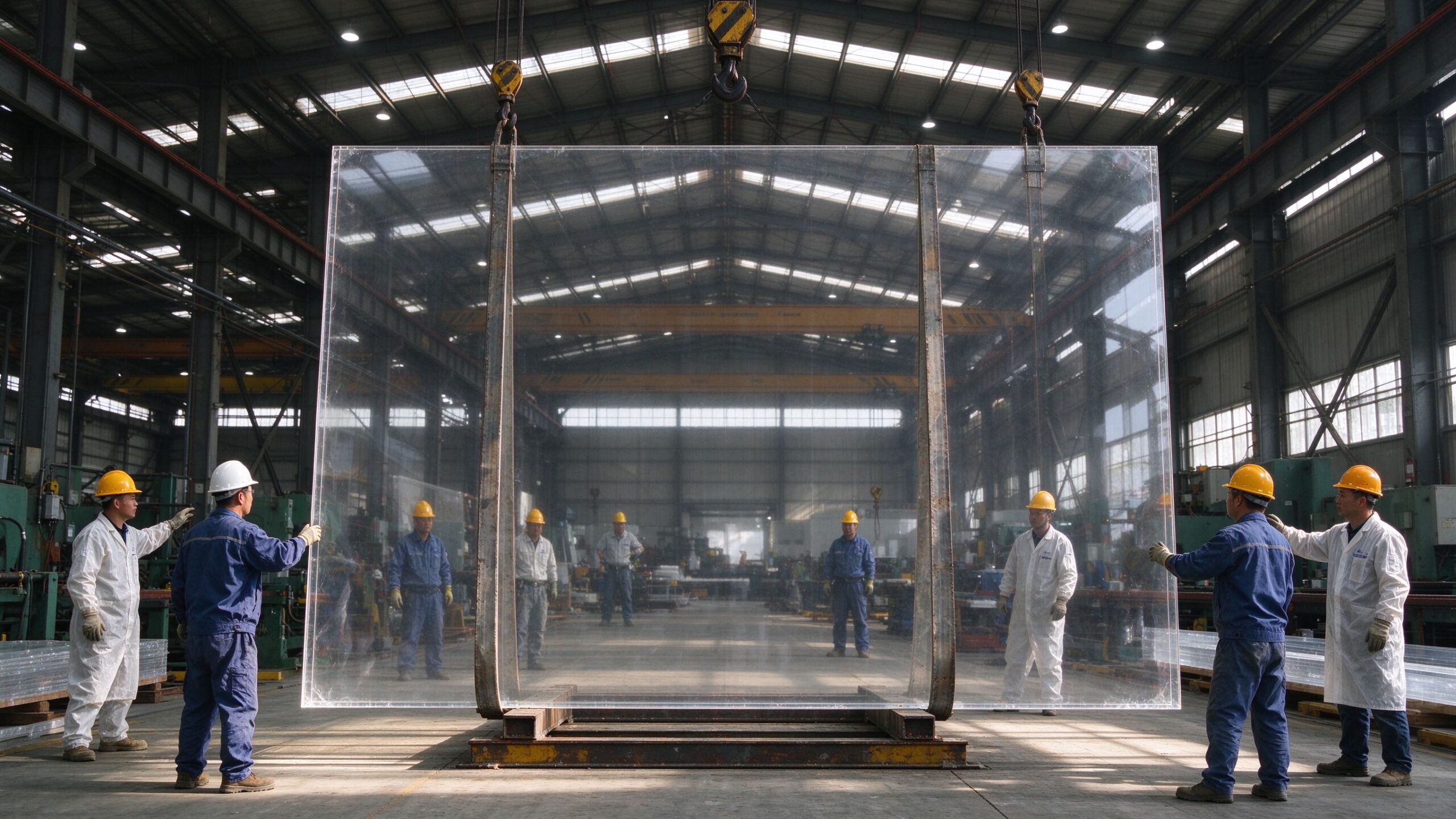
Cast sheet carries the absorber through the full section because it is polymerised with it. Co-extruded sheet puts a thin UV-capable layer on one face, with a cheaper core behind. Both work outdoors; the co-extruded version is thinner in margin and depends on which face you install outward.
That installation question is the trap. A co-extruded panel fitted with the protected face inward behaves like general purpose sheet, and nobody notices until the second summer. Mark the protected face at the factory, and check it on site.
The fixing detail that decides the decade
Outdoor panels move. A 1.5 m panel swings about 7 mm between a cold night and a hot afternoon. Holes drilled at 1.5 times the fastener diameter, with an elastomer washer and 3 mm of clearance, survive that movement. Holes drilled tight and close to the edge do not.
Specify edge distance at 2.5 times hole diameter minimum, and never under 15 mm. This single line prevents most of the cracked outdoor panels we are asked about. More on grade selection lives in this note on why outdoor projects need co-extruded protection.
Cleaning and the maintenance contract
Outdoor panels collect dust, pollen and bird residue, and site contractors reach for whatever is in the van. Alcohol and ammonia stress-crack acrylic; abrasive pads haze it permanently. Write a one-page protocol into the maintenance contract and it will outlast three specifications.
Also specify a rinse-first routine. Dry wiping pulls grit across the surface and the scratches become the reason for replacement long before the UV does. The yellowing and lifespan guide sets out how the two failure modes are separated in a warranty discussion.
None of this is expensive. It is three lines in an RFQ and one line on a handover sheet.
Send the elevation drawing, climate and required service life to oversales@rpplexiglass.com and we will propose a grade with a written lifespan basis.
Frequently Asked Questions
How long does UV resistant acrylic last outdoors?
A cast grade with a proper absorber typically holds clarity for ten years in temperate climates and seven to eight in intense sun. General purpose sheet yellows measurably inside two to three summers.
Is a coating as good as an absorber in the sheet?
No. A coating can scratch off at the edge and leaves a hard-to-repair surface; an absorber in the polymer protects the whole section. Coatings are used where the base polymer cannot carry an absorber, which is not the case for acrylic.
Does yellowing affect strength?
It indicates polymer degradation, and impact strength falls alongside it. A panel that has yellowed by ten units has also lost a noticeable share of its toughness, which matters on a canopy or a balustrade.