
The complaint came from a site manager, not an acoustic engineer: “The wall works. We are finding birds at the foot of it every week.” A clear panel is invisible to a bird in flight, so it flies at full speed into a surface it never saw.
Why clear barriers hit wildlife
Glass and acrylic reflect and transmit light in a way that gives birds no depth cue. Studies of bird-safe glazing converge on the same answer: a visible pattern with limited spacing. The widely used guideline is markings no more than 50 mm apart in at least one direction, with stripes at least 3 mm wide, so a bird’s wingspan always intersects a visible line.
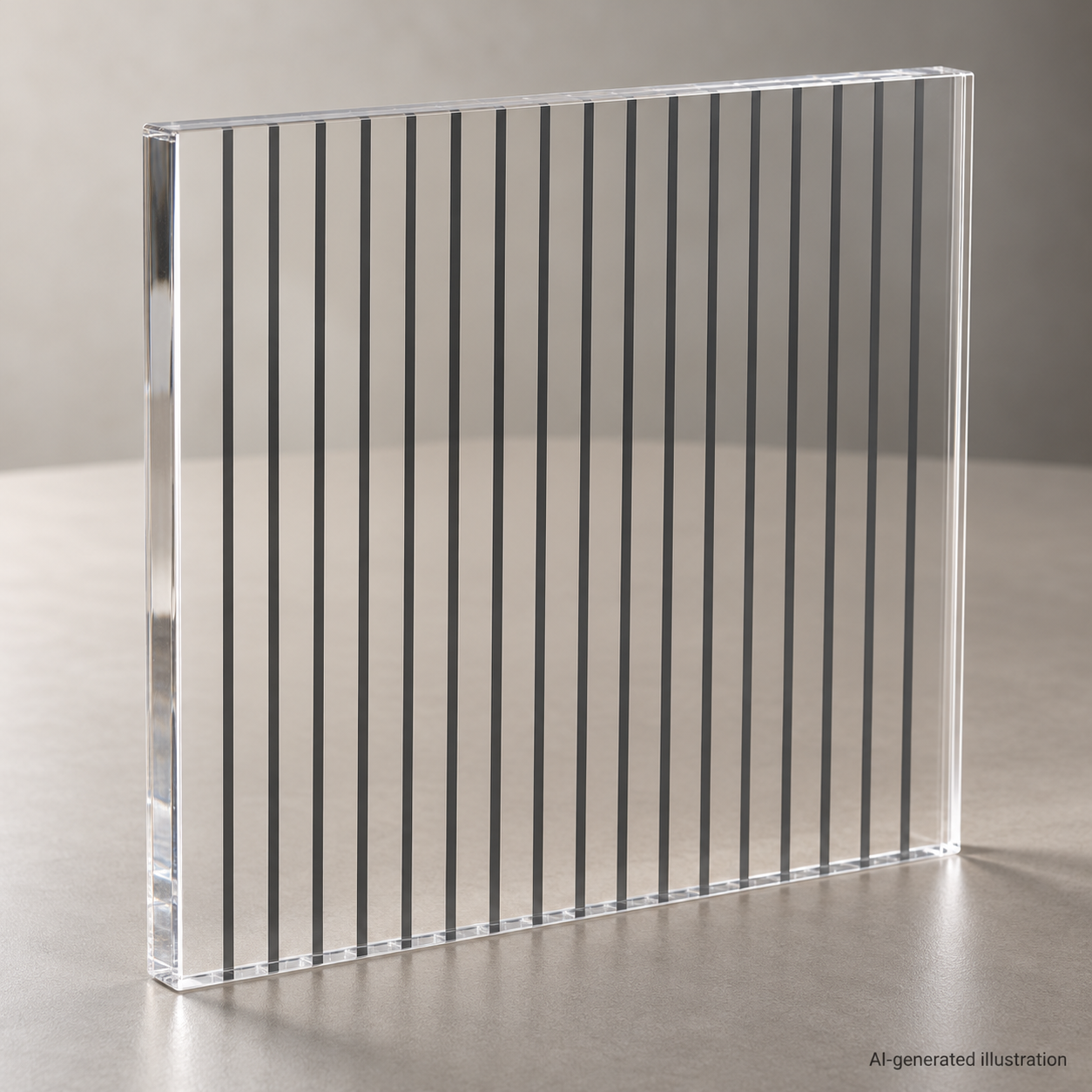
What we printed on a 900 m section
A wetland-adjacent road wall used 15 mm cast acrylic panels, 1,900 mm wide by 3,500 mm high. We applied a UV-cured horizontal stripe pattern: 5 mm lines at 50 mm pitch, white on clear, covering the full panel face, with a 5% open area left unmarked at the very top so the acoustic seal at the frame stayed intact.
- Light transmission dropped from 92% to about 78% — enough for drivers to read the road, not enough to blur the pattern.
- Measured reduction was unchanged at Rw 30 dB, because the ink layer is thinner than a wavelength at barrier frequencies.
- Printing was applied to one face only, so the panel could still be reversed if the pattern needed changing.
Where the pattern goes wrong
Two failures recur. First, spacing: a 150 mm dot grid looks decorative and does almost nothing, because a bird can pass between the marks. Second, coverage: printing only the upper two-thirds leaves the lower band lethal, and that is where low-flying birds and fledglings actually cross. Print the whole face the public can see, and keep the pitch at or under 50 mm.
How the pattern integrates with the barrier build is covered in bird-deterrent acrylic noise barriers, and the retrofit case for existing clear walls in UV resistant transparent noise barrier panels.
Frequently Asked Questions
Q: Does bird-safe printing reduce the noise barrier performance?
A:Not measurably. The cured ink layer is far thinner than the acoustic wavelengths that matter at barrier frequencies, so an Rw 30 dB panel stays at Rw 30 dB. Light transmission falls by roughly 10–15 percentage points.
Q: What stripe spacing stops bird collisions?
A:Marks at or under 50 mm apart in one direction, at least 3 mm wide, over the full visible face. Wider spacing looks neater but lets birds fly between the marks, which is where most of the collisions happen.
Send your sound-wall drawings, span between posts and required Rw to oversales@rpplexiglass.com for a cast acrylic panel quotation with drilling and edge details.