
Iridescent acrylic for interior design has no fixed colour, only a colour response, and that changes everything about approval. An interior designer specified an iridescent acrylic feature wall for a hotel lobby, approved a 100 mm swatch on a desk under office light, and rejected the installed panels on the first evening inspection. Under the lobby downlights the panels read green-gold; the swatch had read pink-violet. The material was exactly as ordered. The approval had been done under the wrong light.
Iridescent acrylic for interior design is a directional material. It does not have a colour; it has a colour response, and that response depends on the angle of view, the spectrum of the light source and the orientation of the panel on the wall. Any specification that treats it like a paint colour will fail at handover.
Two technologies, two behaviours
Interference-coated sheet carries a thin optical film that reflects different wavelengths at different angles. The shift is strong, the effect is surface-based and it is sensitive to handling: a polish or a solvent wipe can remove the coating. Pearlescent sheet carries a pigment through the thickness, with a softer shift, no surface vulnerability and a different price point.
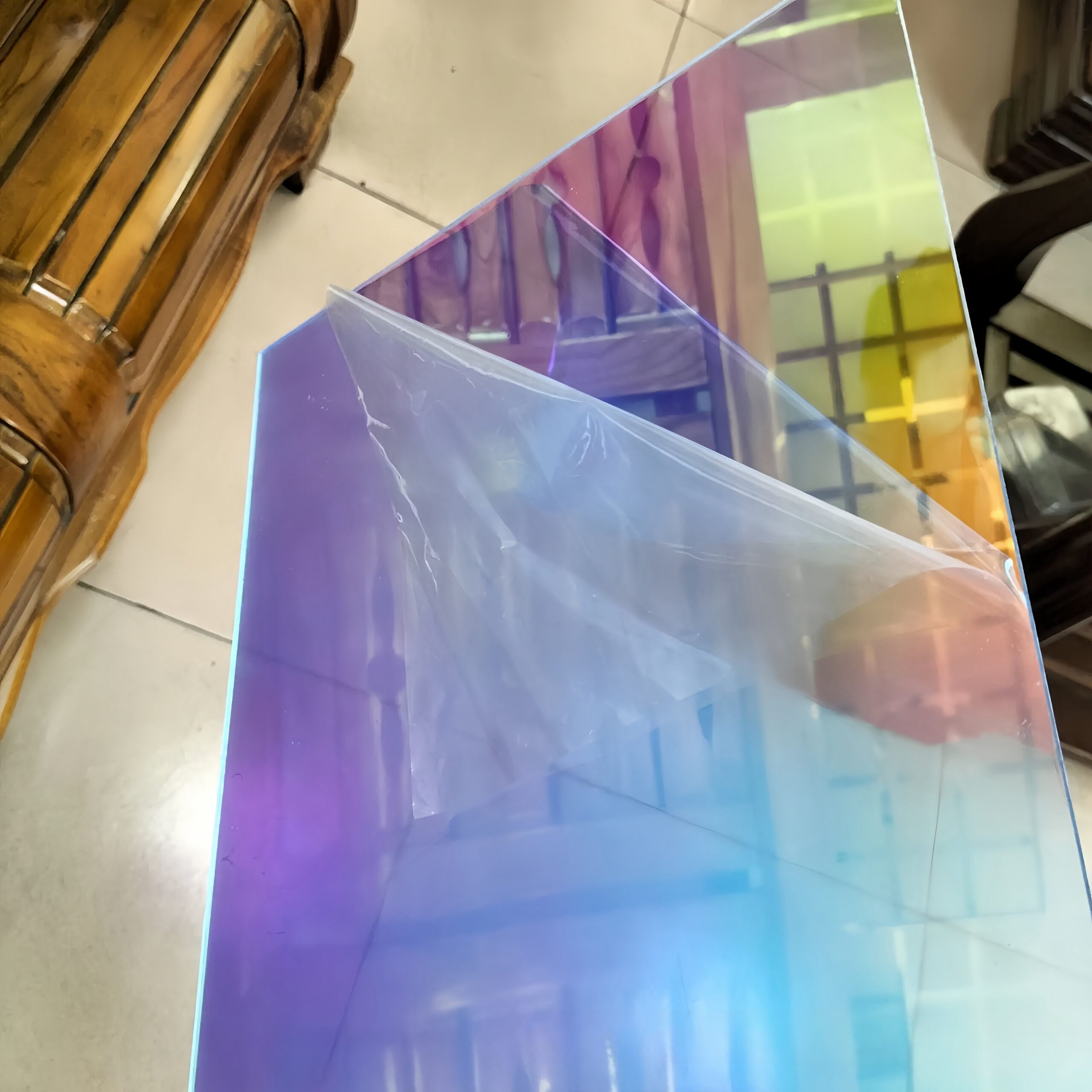
For a feature wall viewed from a distance and lit with a controlled wash, the coating gives the stronger effect. For a surface that will be touched, cleaned and possibly re-polished, the through-colour pigment is the practical choice. Deciding this before the sample is ordered saves a re-selection.
Iridescent acrylic for interior design: orientation and seams
The shift direction is set by the coating or the pigment orientation, so every panel must be cut from the same orientation on the sheet. Mark the sheet with an arrow at cutting, and keep the arrows aligned on the wall. Panels rotated 90° against their neighbour will read as a colour break that looks like a batch mismatch.
Seams should run in the direction of the main viewing axis. A horizontal seam catches light differently from a vertical one, and on a curved wall the seam placement decides whether the shift reads as a gradient or as a stripe. Mock up two panels at the junction on site before the full order is cut.
Lighting and the three-angle approval
Approve the sample under the actual source at three angles: straight on, 30° off axis and 60° off axis. Photograph all three and attach them to the purchase order with the light source colour temperature. That record is what settles the argument at handover, because it defines the effect in the terms the material actually behaves in.
The technical background on coating types, sheen and the interior applications each suits is in our guide to iridescent acrylic sheet.
Cleaning is the maintenance item that decides how long the effect lasts. Use a dry microfiber cloth for dust, water with a drop of neutral detergent for marks, and never a solvent or an abrasive polish on a coated face. On a through-colour pearl sheet the rules are more forgiving, and the options are compared in our note on pearlescent acrylic sheet.
Send the wall layout, light source and viewing direction to oversales@rpplexiglass.com, and we will quote iridescent or pearlescent acrylic panels with an orientation-marked cutting plan and a three-angle sample for approval.
Frequently Asked Questions
Does iridescent acrylic change colour in different light?
Yes. The effect comes from interference or pigment orientation, so the perceived colour depends on the viewing angle and the spectrum of the light source. A 3000 K downlight and a 5000 K daylight source will show different hues on the same panel.
Can iridescent acrylic be cut and drilled?
Yes, with the same tools as standard acrylic, but the cut edge loses the effect and reads as a plain edge. Plan the panel sizes so cut edges land in a frame or a shadow gap, and mark the orientation before cutting so the panels stay aligned.
How do I approve an iridescent panel?
Under the project light source, at three angles, with photographs attached to the order. A desk swatch under office lighting is not an approval, because the installed result will be judged in the space where the panel actually sits.